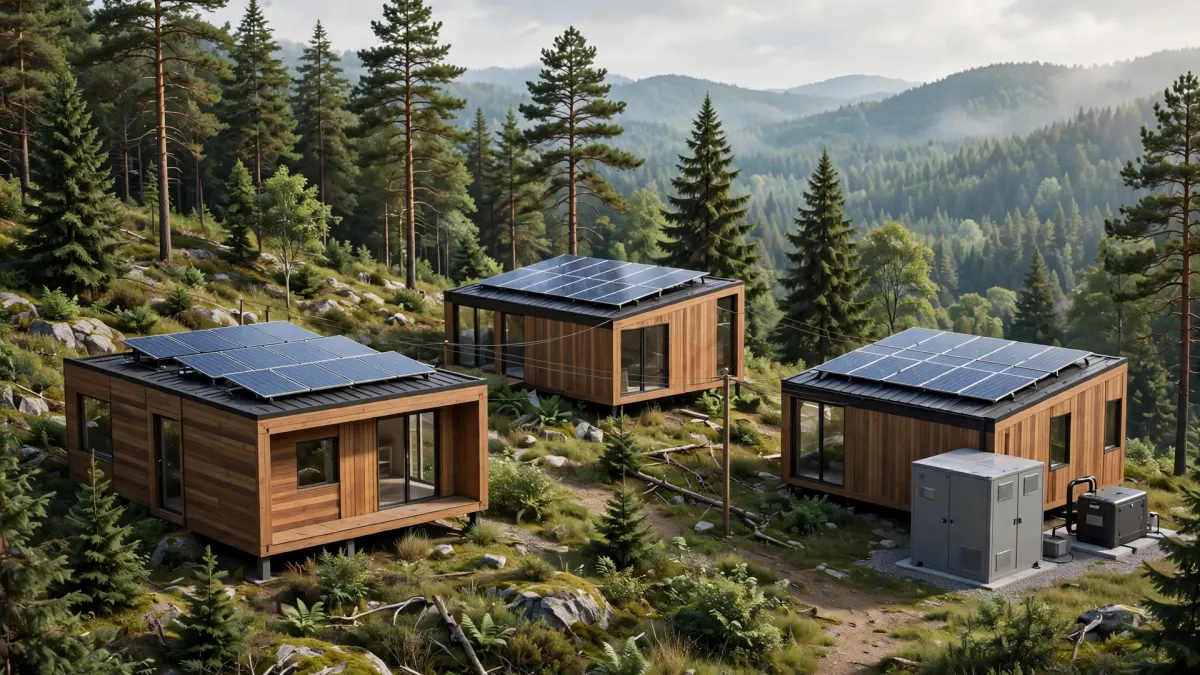
Define what off-grid actually covers
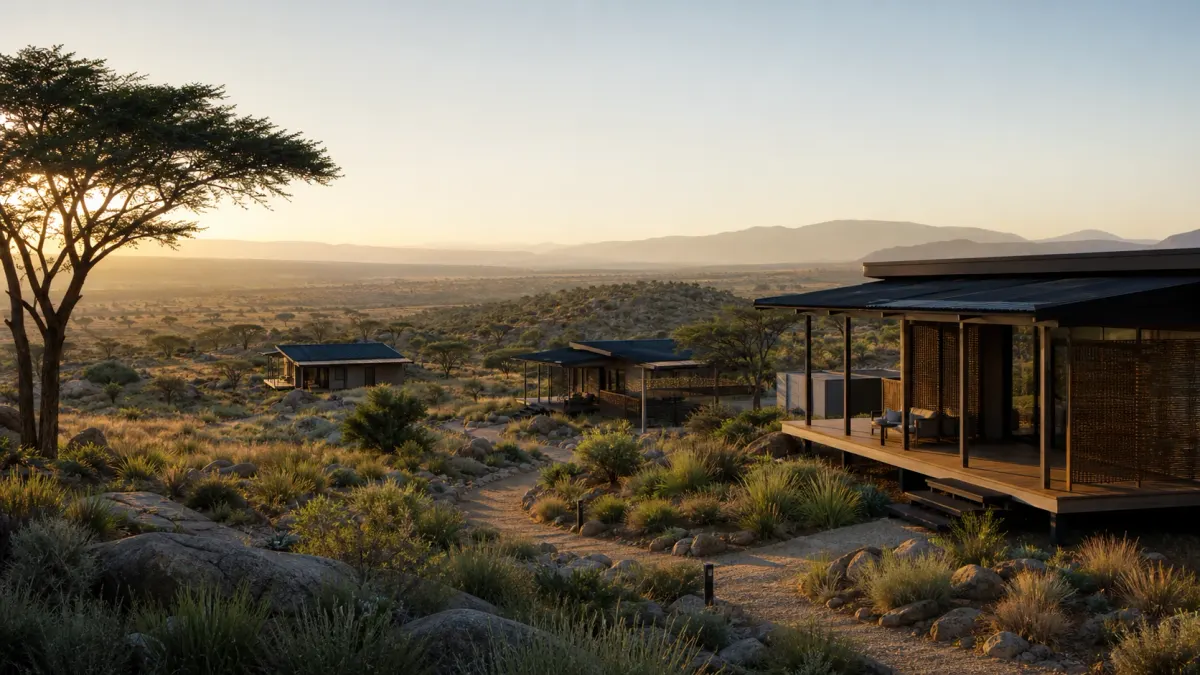
An off-grid cabin cluster is not simply a row of cabins beside solar panels. It is a small electricity system whose supply, storage, controls and backup must cover a defined service promise when no dependable utility connection is available. Start by saying whether the system supports year-round occupancy, seasonal stays, emergency-only use, or a restricted schedule. Record which loads are essential and which may be curtailed. The word “off-grid” does not promise uninterrupted air-conditioning, electric hot water, laundry or vehicle charging under every weather condition.
A project brief should name the number and configuration of cabins, occupancy assumptions, shared buildings, site lighting, water pumping, communications and operating staff. It should also define the autonomy target, acceptable backup operation, fuel logistics and what happens after several low-solar days. Battery capacity and panel count are results of these decisions, not starting specifications. The destination electrical designer and qualified installer must validate design, installation and protection requirements for the actual site. Foundations, local installation, utilities, permits, inspections and final approval remain destination-side responsibilities. Factory supply documents cannot transfer those duties to an exporter.
Build a load register before selecting equipment
Create one register covering every electrical end use, not just the cabin nameplate. For each item record rated input power in watts, expected running power where supported by credible equipment information, quantity, hours per day, seasonal use, likely coincidence and start-up behavior. Identify the source for each assumption. Separate appliance energy consumption in kilowatt-hours from instantaneous demand in kilowatts. A high-power appliance used briefly can dominate inverter sizing even when it contributes relatively little daily energy.
Group loads as critical, schedulable or discretionary. Critical loads might include required lighting, communications, refrigeration, water and any safety-related equipment identified by local professionals. Laundry, pool treatment and guest EV charging may be rescheduled if the operating agreement allows it. Review the schedule with housekeeping, facilities and booking teams: an assumption that only one shower or washing machine runs at once is not a control strategy unless the property actually enforces it. Keep the first register as an auditable spreadsheet with equipment revisions and unresolved inputs, so later value engineering does not silently discard loads.
Calculate daily energy by season and occupancy
For each load, calculate daily energy as input power multiplied by operating hours and quantity, divided by one thousand when power is in watts. Summing these entries creates a baseline kilowatt-hour-per-day estimate, not a final generation specification. Develop distinct occupied-high, occupied-low, service-day and vacant-season profiles. Cabin turnover, cleaning and maintenance can create demand even when guests have checked out. Include overnight use, exterior lighting, common rooms and continuous electronic standby where relevant.
Do not use a single annual average as the decisive number. Weather, occupancy and hot-water use may be correlated: cold days can increase heating and water demand while reducing solar yield. Hot days can put cooling near its highest load when evening guest activities begin. Use locally appropriate weather data and equipment performance curves to construct monthly or more detailed profiles. Label modelled data as assumptions rather than measured site results. Carry uncertainty bands for occupancy and equipment choice; a range communicates the design question more accurately than a falsely precise daily total.
Distinguish inverter power from battery energy
The energy ledger answers how many kilowatt-hours must be served. The coincident-demand schedule answers how much power the system must deliver at a particular moment. Construct plausible morning, afternoon, evening and night operating periods, then add the loads that can actually overlap. Include motor starting characteristics, power factor where relevant, inverter surge capability and any required three-phase equipment. A nominal device rating is not always the demand seen by the inverter; the selected equipment data and qualified electrical design must resolve that difference.
Consider what happens when several cabins call for HVAC, shared laundry restarts and a water pump operates. The cluster may need load-management interlocks, staged starts or protected circuits rather than an indiscriminately oversized inverter. Show which loads are rejected or deferred after a fault, and how operators receive an alarm. Write separate normal-operation and critical-operation peak schedules. This makes backup mode a defined operating state, not the unsupported expectation that every appliance will continue as usual.
Account for lighting and shared support loads
Lighting is comparatively straightforward to schedule, but only when the register includes exterior paths, arrival points, security requirements, plant rooms and staff areas. Distinguish daylight-linked control from fixed night lighting and any safety functions that must remain available. Record both lamp demand and the hours imposed by the operating plan; do not assume occupancy sensors can be applied indiscriminately. Include routers, access controls, monitoring devices, refrigerators, ventilation, wastewater equipment and water pumps in the same system boundary.
Shared infrastructure can be more important than an individual cabin load. Pumping may depend on storage elevation and the destination water design. Wastewater treatment may require continuous aeration or particular restart procedures. A security or communications circuit may need a small protected supply distinct from guest services. Request load and duty-cycle information from each specialist, then identify whose responsibility it is to make that equipment compatible with the proposed electrical architecture. The result should be a list that a commissioning team can reconcile with equipment actually installed at the destination.
Model HVAC with the cabin envelope and climate
Heating and cooling demand depends on more than an equipment label. The relevant inputs include the cabin envelope, glazing, air leakage, ventilation, shading, orientation, occupancy, indoor setpoints and local hourly temperature patterns. Ask the building-services designer to model the proposed cabin types and confirm available equipment performance under those conditions. A catalogue seasonal efficiency figure does not establish actual power demand during the site's most difficult hour or during a defrost cycle.
Separate thermal loads from electrical input and distinguish start-up demand from steady operation. Identify whether cabins are conditioned continuously, preconditioned before arrival or allowed to drift when unoccupied. Include staff and service rooms if they operate through different hours. Where a load-shedding plan exists, state minimum acceptable indoor conditions and the people responsible for guest communication. For extreme weather, decide whether backup generation can serve the full comfort load or whether occupancy must be restricted. Do not claim that insulation alone eliminates the need for backup; resilience depends on design conditions and an agreed operating response.
Treat hot water and laundry as controllable processes
Electric resistance water heating can place a concentrated demand on a small off-grid system. Heat-pump water heaters change the relationship between heat delivered and electrical input, but their performance and operating limitations depend on surrounding temperatures, installation and duty cycle. Start with guest numbers, shower patterns, staff use, storage temperature policy, water availability and hygiene requirements set by the responsible destination team. Separate electrical energy needed to heat water from peak input power and the storage capacity available to shift heating across the day.
Laundry requires a process schedule: washing, water pumping, drying, ventilation and possible water heating. The peak may coincide with cabin turnover rather than overnight occupancy. Specify whether linen is processed on site, consolidated into daytime batches or serviced elsewhere. A controls proposal might delay reheating or drying until solar production is available, but only if it preserves hygiene, turnaround needs and equipment requirements. Document override authority and what happens during prolonged low-generation periods. A “solar-friendly” label is not a substitute for an enforceable duty schedule or a reviewed plumbing and electrical design.
Put EV charging behind an explicit energy budget
Guest vehicle charging can overwhelm the daily cabin energy budget if unlimited charging is assumed. State the number of charging positions, maximum permitted input, likely arrival pattern, energy allowance per vehicle and how requests are allocated when solar generation is low. A charger rating describes a possible power draw, not energy guaranteed to every guest. Include conversion losses and any site network or metering needs in the engineering review, without presenting a universal loss percentage as a fact.
The operating policy should offer a clear choice: no charging, charging by prior arrangement, charging within a daily energy cap, or a separately managed supply. If charging is schedulable, document who can pause sessions and how guests will know their allocation. Account for the effect of charging on battery reserve and generator runtime. Do not use the campground grid-upgrade sequence as the design model here: this project has no assumed firm grid supply to sequence against. The question is how much renewable energy and dispatchable backup the cluster can responsibly allocate after critical cabin services are protected.
Size the solar array against the difficult season
PV sizing begins with the site's solar resource, not a panel manufacturer's maximum rating. Obtain location-specific irradiation information, model the intended module tilt and orientation, and account for shading, temperature, soiling, wiring, conversion and operational availability. Express the calculation as expected energy for each representative period with assumptions and uncertainty visible. A simplified preliminary relationship is daily energy required divided by usable daily solar yield per installed kilowatt; its inputs must be site-specific and the result must be checked with more detailed modelling.
Assess the weakest relevant season and the variability within it, not just a sunny annual average. Roof area, ground layout, equipment access, wind exposure, drainage and maintenance routes may constrain the physically installable array. Leave room for safe electrical isolation and future servicing under local rules. Consider whether a staged deployment changes the load mix or merely postpones the same deficiency. A larger array may help recharge after poor weather but cannot remove every multi-day generation shortfall. Record the conditions under which backup or curtailment remains necessary.
Specify storage as usable energy and operating reserve
Battery selection must distinguish nameplate energy from energy available to the loads after depth-of-discharge limits, temperature effects, conversion losses, ageing allowances and operating reserve. Establish the design autonomy period and calculate the supported critical-load energy during that period. Then have the storage designer test charging opportunities, discharge power, inverter compatibility, control behavior and any battery thermal-management consumption. Autonomy is a service definition tied to a specified load; “two days of battery” means little without naming the loads and conditions.
Separate normal cycling reserve from protected emergency reserve. Set measurable operating thresholds: when discretionary loads stop, when guests receive notice, when the generator starts, and who may override a limit. Ask for appropriate battery safety, location, ventilation or fire provisions to be determined by the destination specialists and applicable rules; do not infer suitability from a generic battery brochure. Include maintenance access, monitoring, service replacement and end-of-life planning. A storage proposal is incomplete unless it explains degraded-capacity operation and recovery after an unusually long cloudy interval.
Design backup, controls and failure response together
A backup generator or alternative dispatchable source closes the gap between variable solar energy and the agreed service obligation. Size it for the loads it must carry, allowable starting transients and any simultaneous battery charging, with the electrical designer confirming interface and protection requirements. State whether backup covers essential circuits only or wider guest comfort. Fuel delivery, storage, emissions, noise, maintenance, staffing and site access are practical constraints; none is solved by increasing battery capacity on paper.
Write a dispatch sequence for ordinary days, low-state-of-charge warnings, sustained poor weather, maintenance and equipment failure. Confirm how the system starts, transfers, sheds load and returns to renewable operation. Decide what happens if automatic controls or communication fail, and retain safe manual procedures for trained personnel. Test plans should distinguish factory-supplied equipment checks from integrated tests at the actual site. Do not describe unperformed tests as completed or promise continuous service without the local design, operating resources and accepted commissioning evidence to support that promise.
Turn calculations into a buyer-controlled design pack
The procurement output should be a traceable design-input pack: cabin and common-load register, seasonal energy profiles, coincident peaks, critical-load definition, weather and solar data sources, PV assumptions, usable battery capacity basis, backup duty, control thresholds and open risks. Add an electrical single-line concept, installation boundaries, equipment schedules and revision ownership for development by qualified professionals. Ask suppliers to identify exclusions and the operating condition behind each stated capacity. Compare proposals against the same assumptions instead of comparing panel or battery quantities alone.
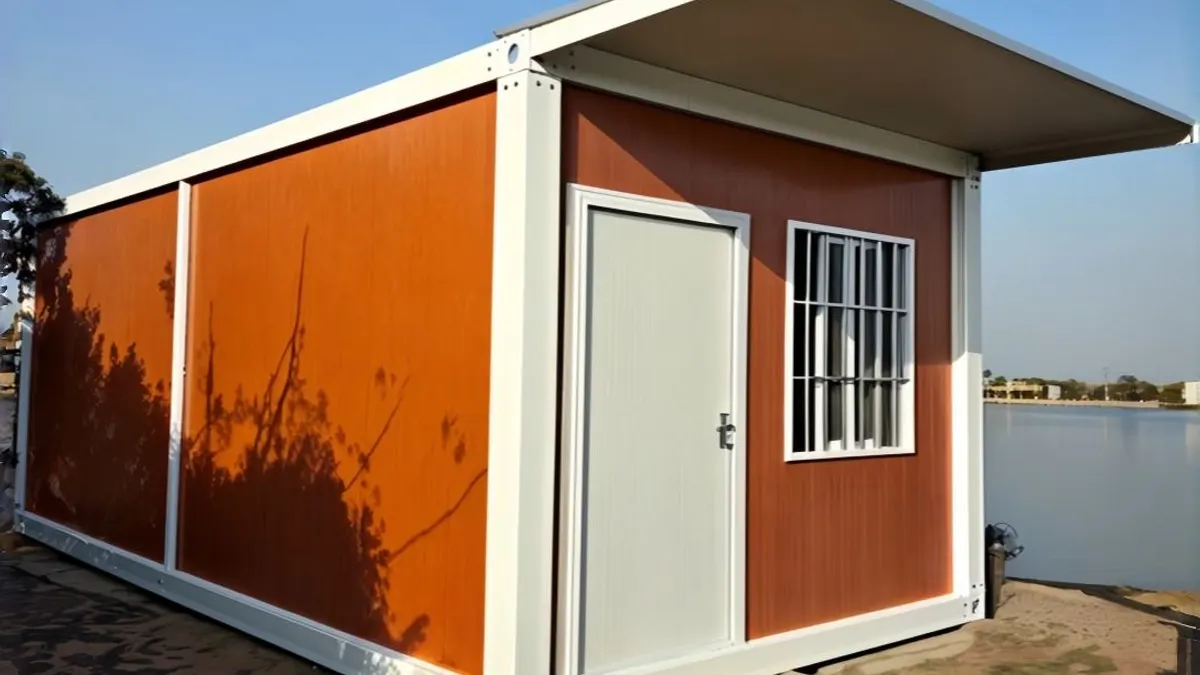
For an MK Mobile House inquiry, communicate the cabin layouts, proposed appliances, utility interfaces and destination conditions; request only the product and factory documentation that forms part of the agreed scope. The local project team remains responsible for foundations, local installation, utilities, permits, inspections and final approval, including the complete off-grid electrical system where applicable. Revisit the load model when cabin quantities, operating season, HVAC, hot water or charging policies change. The responsible professionals must validate the final design; this guide is a method for preparing questions, not electrical engineering approval.
Sources
- NREL PVWatts Calculator — a modelling resource for preliminary site-specific PV generation estimates, not a project guarantee.
- NREL National Solar Radiation Database — solar-resource data and documentation; geographic availability and suitability require checking.
- U.S. Department of Energy: Energy Saver, Solar Energy — general solar-energy context, not a design standard for a cabin cluster.
- MK Mobile House: Technical Resources — public factory/project handoff materials; not proof of destination electrical approval. These references inform the planning method. No measured performance, equipment certification, actual project test or uninterrupted off-grid service is asserted.