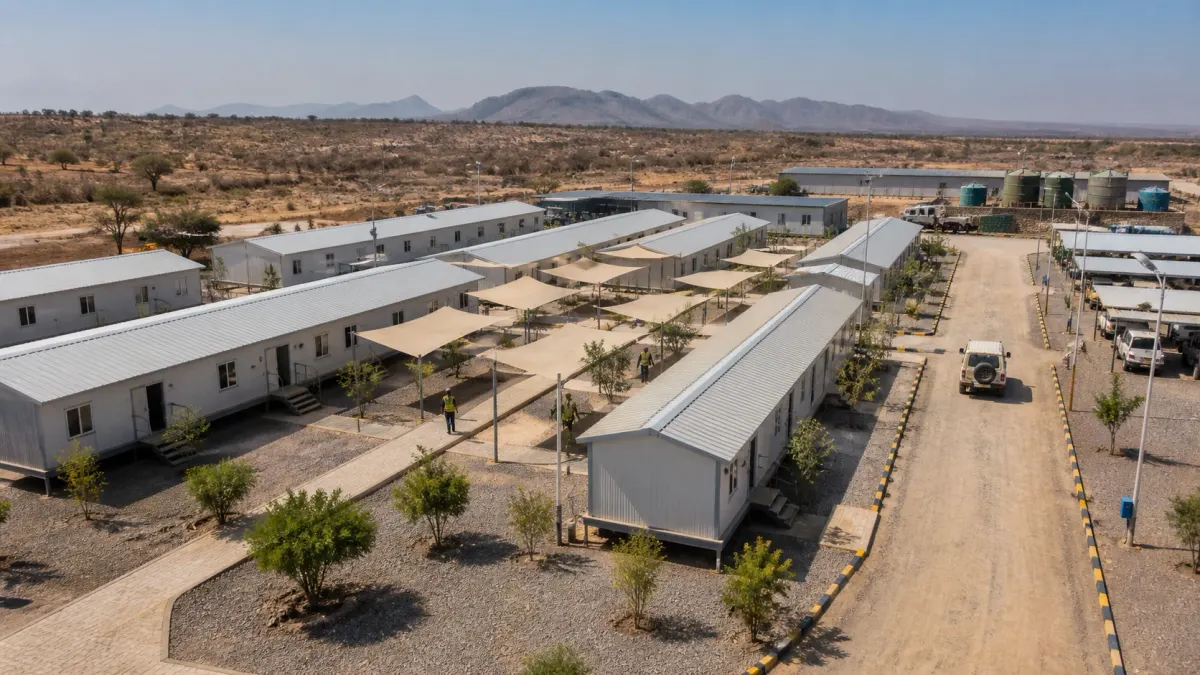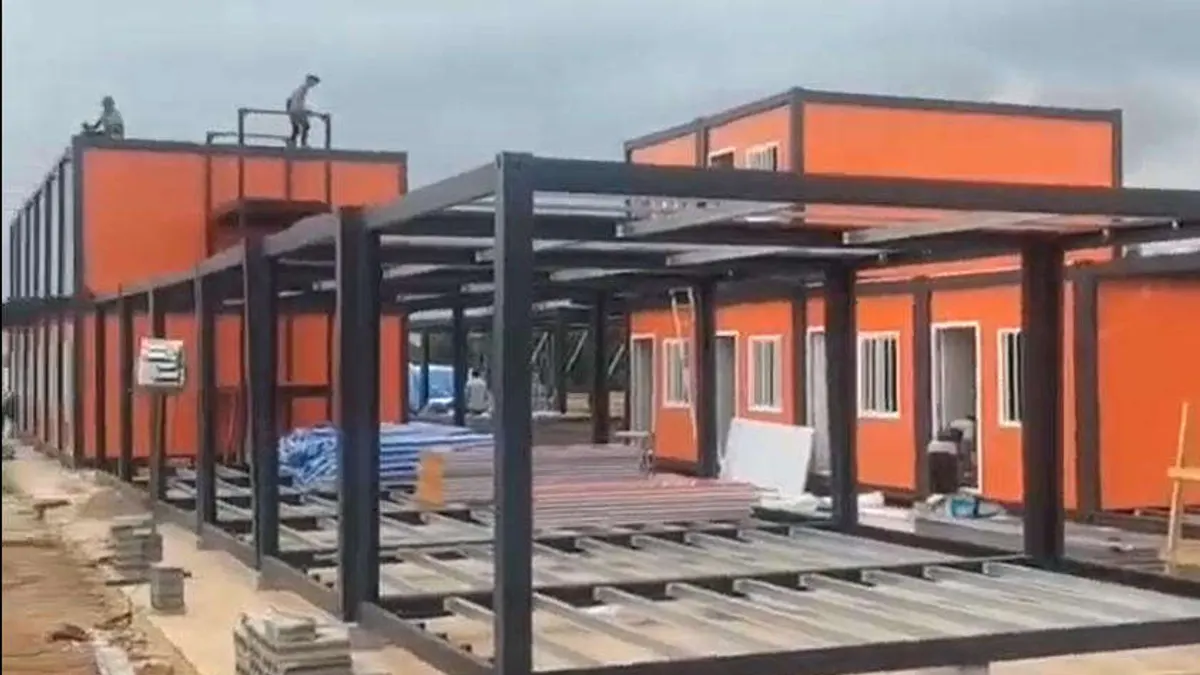
The cover is an AI-generated editorial concept, not a photograph of a completed project or evidence of a government approval.
A headline total built from 774 small decisions
On 16 October 2026, Voice of Nigeria reported that the Minister of Housing and Urban Development had announced plans to build 100 housing units in each of the country's 774 local government areas under a Social Housing Programme, describing the total as 77,400 units nationwide. The same report described mortgage delivery targets and a proposed increase in the maximum mortgage loan.
The arithmetic is simple. The delivery problem is not. A national figure of 77,400 units is the sum of 774 separate local decisions, each involving land, services, access, a procuring entity, an approving authority and an eventual operator. Any one of those can stop a site. Most of them are invisible at the level of the national total.
That is why the useful planning question is not "how do we build 77,400 units?" but "what has to be true before the first hundred units in a given area can be built, inspected and occupied?" The answer determines whether a factory-built approach helps or merely adds a new dependency.
This article treats the announcement as an announced plan. It is not evidence of appropriations, land allocation, procurement, construction or completion. No unit type, budget, timetable or delivery method is asserted beyond what the report states.
Why "100 per LGA" is a planning unit, not a project
A local government area is an administrative boundary, not a construction site. Within one area there may be urban plots with paved access and piped water, peri-urban land without services, and remote settlements reached by seasonal roads. A single unit count applied across that range conceals more than it reveals.
The first task is therefore to translate the target into candidate sites. A candidate site needs a defined boundary, a documented ownership or allocation position, a realistic access route and a servicing concept. Without those four, a site cannot be scheduled, priced or approved, regardless of how suitable the building type appears.
The second task is to group sites by constraint rather than by geography alone. Sites with similar access, ground conditions and service availability can share a unit design and a delivery method. Sites with different constraints may need different solutions even within the same local government area. Grouping by constraint is what makes repetition useful; grouping by map colour usually does not.
The third task is to size the first batch honestly. A batch that is too small may not justify mobilisation, tooling or a dedicated production line. A batch that is too large commits the programme before the first site has demonstrated that the model works. The right size is the smallest batch that produces a verifiable result and a reusable lesson.
Map the 774 areas before choosing any site
A national programme needs a screening layer before it needs a design. The screening layer should be built from information that can be checked, not from assumptions about need.
The first screen is population and household demand in the area, including whether the target is intended for a specific group such as civil servants, artisans or informal-sector workers. The second is land: whether sites are publicly held, allocated, under customary tenure or subject to dispute. The third is hazard: flood plains, erosion, coastal exposure and slope stability. The fourth is access: road condition, seasonal passability, bridge limits and the distance from a practical delivery route. The fifth is servicing: water source, power, sanitation and waste options.
A programme that skips this layer tends to produce a design that works on paper and fails on the first difficult site. A programme that completes it can rank areas by readiness rather than by political visibility, and can explain why some areas are sequenced later.
The screening output should be a short, auditable record per area: the candidate sites, the constraint that dominates each, and the evidence behind the ranking. That record is also the basis for an honest conversation with a manufacturer, because it shows where repetition is real.
Separate social housing from emergency shelter
Social housing and emergency shelter are often discussed together because both involve public delivery and temporary-looking units. They are different products with different expectations.
Social housing implies a durable home with secure tenure arrangements, functioning services, and a maintenance path that extends beyond the construction contract. Emergency shelter implies rapid provision, shorter design life and a different standard of service. A unit designed for one purpose may be technically usable for the other, but the operating assumptions do not transfer automatically.
A programme that blurs the two tends to under-specify durability and over-specify speed. It may also create a maintenance liability that no one has budgeted for, because the unit was justified as a short-term measure and then occupied for years.
The practical discipline is to state the intended life, the intended tenure and the intended service level for each batch before selecting a construction method. Those three statements determine whether a relocatable unit, a permanent modular building or a conventional build is appropriate. They also determine what the buyer should ask a supplier to evidence.
Test whether modular units suit the site
Modular construction is a delivery method, not a site solution. Whether it suits a particular site depends on a set of physical and institutional conditions.
The physical conditions include the transport envelope, the route from the factory or port to the site, the lifting position, the ground bearing capacity and the ability to deliver and install without closing a road or displacing residents for long periods. The institutional conditions include the approving authority's familiarity with factory-built systems, the availability of inspection capacity at the factory, and the local professional team's willingness to accept interface responsibility.
Where sites are small, scattered and poorly connected, the transport and lifting burden can outweigh the speed advantage of factory production. Where sites are clustered and accessible, and where the same unit type repeats, the case is stronger. The decision should follow the site pattern, not a general preference for or against modular.
A useful test is to take the three most difficult candidate sites and ask whether the same unit can reach all three. If it cannot, the programme needs either a different unit for those sites or a different delivery method for them. Discovering that before production is cheaper than discovering it at the gate.
Define a repeatable core unit without freezing the site design
Repetition is what makes factory production efficient, but premature repetition is what makes housing programmes rigid. The resolution is to separate a stable core from site-dependent variation.
The stable core should include the structural system, the room module, the wet-area layout, the window and door schedule, the service entry points and the performance specification. These are the elements that benefit most from standardisation and are least likely to change site by site.
The site-dependent layer should include foundation type, orientation, external works, service connections, access, landscaping and any climate adaptation. These vary legitimately and should not be forced into a single solution in the name of standardisation.
The boundary between the two layers should be written down and owned. A change to the core should require a defined approval, because it affects tooling, production and repeatability. A change to the site layer should be expected and priced, because it will happen.
This structure also gives the programme a way to learn. If several sites need the same variation, it may be a sign that the core should change. If every site needs a different variation, the programme may not have enough repetition to justify a factory approach.
Plan infrastructure before the first batch
Housing units without services are structures, not homes. The infrastructure that must precede occupation is often the longest-lead item in a social housing programme, and it is frequently the item least integrated with the building contract.
Water supply, sanitation, drainage, power, access roads and waste collection each need an owner, a design, a funding source and a completion date that precedes occupation. In many programmes these are split across different agencies, which makes coordination the critical skill rather than construction.
A practical approach is to treat infrastructure as a gate rather than a parallel workstream. The first batch should not be released for occupation until the services it depends on are commissioned or formally scheduled with a date and an owner. If a service cannot be delivered on that timeline, the batch should be re-sequenced rather than occupied without it.
This gate also protects the reputation of the programme. A completed unit that cannot be occupied because the water connection is missing becomes evidence against the delivery method, even when the building itself performed as intended.
Structure procurement around batches, not the headline total
A national target invites a single large procurement. A delivery programme needs a sequence of smaller ones, each with a defined scope and a defined exit.
The first procurement should cover a pilot batch in a small number of screened areas. Its purpose is to test the unit, the delivery method, the inspection regime and the operating assumptions. The second procurement should incorporate what the pilot proved and correct what it did not. Later procurements can expand once the model has demonstrated that it works.
This sequencing has three advantages. It limits the cost of being wrong. It creates real evidence for later decisions. And it gives manufacturers a credible basis for investing in capacity, because they can see a path from a pilot to a programme rather than a single uncertain tender.
The procurement documents should state what is being bought, what evidence is required, how variations will be priced and what happens if a site is not ready. Those clauses matter more in a multi-site programme than in a single building, because the number of interfaces multiplies.
Assign local roles and evidence
Every programme needs a clear answer to a short set of questions. Who owns the land and can grant access? Who approves the building design? Who inspects the factory work and the site work? Who connects the services? Who maintains the unit after handover? Who is accountable if a unit is occupied before its services are ready?
These questions are not bureaucratic. They determine whether the evidence produced at each stage will be accepted by the next party. A factory inspection record that the local authority does not recognise is not evidence of compliance, however thorough it is. A service connection certificate issued by the wrong entity creates a dispute, not a handover.
The programme should maintain a responsibility matrix that names the party for each function and the document that proves it. The matrix should be reviewed at each batch, because responsibilities often shift as a programme moves from pilot to scale.
Work through a hypothetical 100-unit LGA batch
Consider a hypothetical batch of 100 units in one local government area. The numbers and sites are illustrative; no real allocation, price or approval is implied.
The screening identifies five candidate sites. Two have secure land and paved access but no piped water. One has water and power but seasonal road access. Two are in a flood-prone area and are deferred.
The programme decides to start with the two serviced sites and 40 units, not the full 100. The core unit is fixed for the structural system, room module and wet areas. Foundations and external works remain site-specific.
The infrastructure review finds that the water connection for the first site can be completed in the same window as the first batch, but the second site depends on a mains extension with no confirmed date. The programme re-sequences: the first site proceeds, the second waits for the mains date.
The procurement covers the first 40 units with an option for the next 20, subject to the pilot inspection and the service confirmation. The responsibility matrix names the land owner, the approving authority, the utility, the factory inspector and the maintenance operator.
The gate decision is "proceed for 40, hold for 60". That is a more useful outcome than a commitment to 100 units that would have hidden the servicing constraint until occupation.
Use a proceed, pilot, pause or decline matrix
Four decisions should be available at each site or batch, and each should be recorded with its evidence.
Proceed means the site, services, approvals and funding are sufficiently confirmed to begin. Pilot means a small batch is justified to test the model before wider commitment. Pause means a material condition is unresolved and a review date is set. Decline means the site is not suitable for this programme, typically because land, hazard or access cannot be resolved within a reasonable period.
The matrix should also record the cost of reversal. A pause that lasts a year may be more expensive than a decline decided early. A pilot that is too small to produce a usable lesson may be a wasted year. The point is to make the trade-off explicit rather than defaulting to optimism.
Prepare a credible first submission
A supplier approaching this programme should prepare a submission that answers the questions a public buyer will actually ask. That means a clear statement of what the supplier does and does not provide, evidence of comparable work, a description of the factory inspection regime, a transport and installation method, a maintenance concept and a realistic view of local content and employment.
It also means being honest about constraints. A supplier that claims to serve all 774 areas equally is less credible than one that identifies the areas where its method fits and explains why. A supplier that presents a single unit for every site is less credible than one that shows how the core adapts.
The most useful first submission is short, specific and verifiable. It should make it easy for the buyer to see what would be tested in a pilot, and what evidence would be produced.
Sources
- Voice of Nigeria, "Nigerian Government Targets 77,400 Housing Units Nationwide", 16 October 2026. https://von.gov.ng/nigerian-government-targets-77400-housing-units-nationwide/
Source note: the report covers statements made at the closing ceremony of the 15th National Council on Lands, Housing and Urban Development in Sokoto. It describes an announced plan and related mortgage targets; it does not report appropriations, land allocations, procurement awards or completed units. A separate ministry release describing a larger national housing target was published on 19 October 2026, after this article's date, and is deliberately not used here. The screening method, hypothetical batch and decision matrix are original editorial analysis.