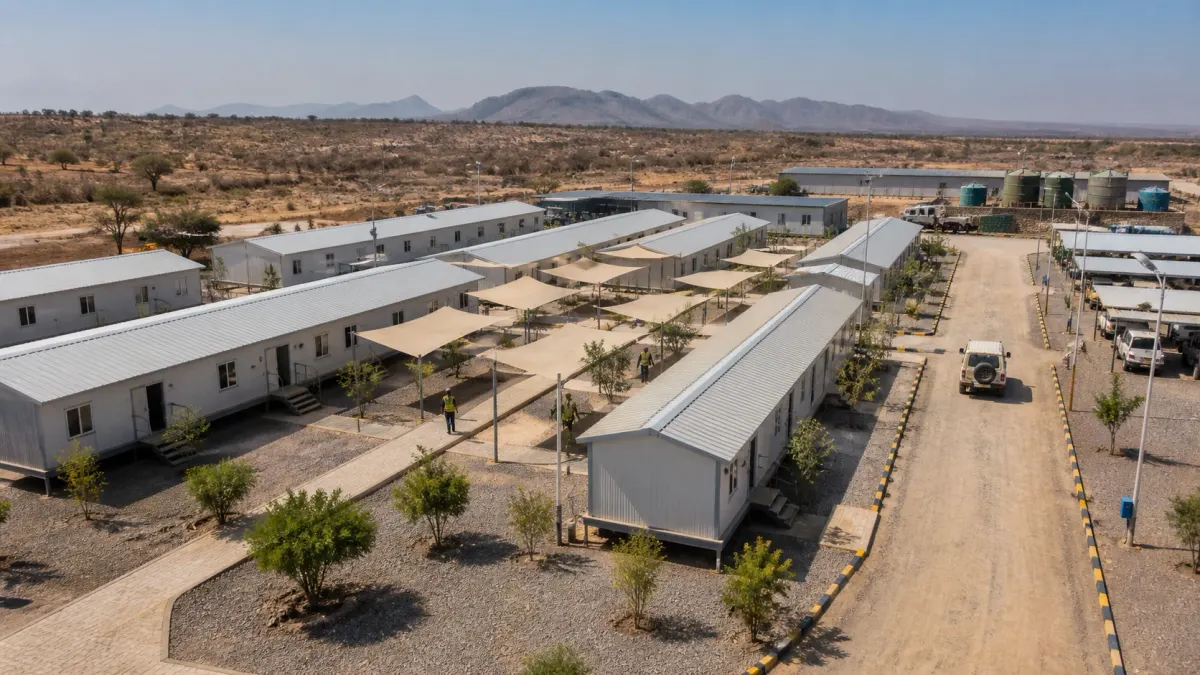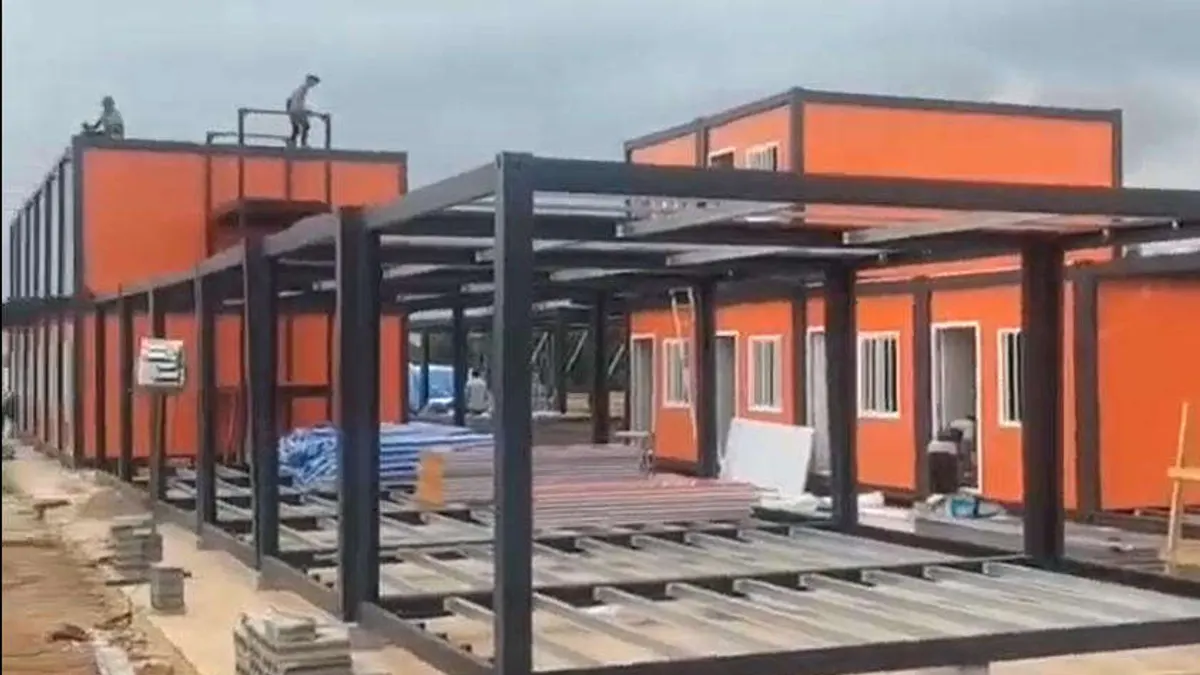
The cover is an AI-generated editorial concept, not a photograph of a completed project or evidence of a tender award.
A panel, not a purchase order
On 23 October 2026, the City of Johannesburg published a notice stating that the Johannesburg Social Housing Company, JOSHCO, is inviting manufacturers and suppliers of innovative building technologies to tender for a place on its panel. The advertisement directs interested parties to JOSHCO's tenders page from that date.
The JOSHCO tender page describes the same appointment in more specific terms: a panel of contractors for the design, manufacturing, supply and installation of innovative building technologies, on an as-and-when-required basis, for a period of 36 months from the date of award.
Those two sentences establish something worth understanding precisely. A panel is a standing arrangement: the buyer establishes a set of appointed suppliers and then draws on them as needs arise. It is not a project award, and it is not a framework allocation with a committed value. "As-and-when-required" is the phrase that carries this meaning, and it should be read as a limit rather than a formality.
For a supplier, the practical implication is that a successful panel application buys a position, not revenue. That position may be valuable — it can shorten the route to future work and it signals a qualification to other buyers — but a business case that depends on a specific volume from a panel appointment is built on an assumption the notice does not support.
Read the scope before the category
The panel scope is broader than a product supply contract, and that breadth should drive the application.
The tender title covers design, manufacturing, supply and installation. That means a supplier's position on the panel may be tested across four capabilities rather than one. A company that manufactures well but relies entirely on others for installation is not necessarily disqualified, but it should describe its position honestly and identify who performs the parts it does not.
Design deserves particular attention. In a public housing context, "design" may mean anything from a standard unit configuration to project-specific adaptation to the local conditions of a particular site. A supplier that presents a catalogue and calls it design capability will be tested at the first request that does not match the catalogue.
Maintenance is the capability the title does not name but the context implies. Social housing assets are held and operated over decades, and a panel supplier that cannot support what it installs creates a problem for the buyer after the contract ends. Whether maintenance is formally in scope should be read from the official documents; whether it matters operationally is not in doubt.
Match your real capability to a named category
The announcement names four categories of interest: temporary residential units, modular containers, non-sewered sanitation systems, and energy- and water-saving technologies.
These are not variations on one product. A temporary residential unit is a habitable structure with a life-safety and amenity profile. A modular container used for accommodation, storage or services has a different specification and a different approval question. Non-sewered sanitation is a utility system with its own servicing, sludge management and health requirements. Energy- and water-saving technologies are a broad family that could include fittings, controls, generation, storage or monitoring.
A supplier should choose the category or categories it can evidence and resist the temptation to claim all four. The reasoning is practical rather than modest. A submission that spreads across categories will be assessed against criteria it cannot meet in each, while a focused submission can be assessed as strong in one.
The category choice should also reflect what the supplier can actually deliver at the scale a social housing institution might require. A pilot-grade product with a handful of installations is a different proposition from a repeatable unit with a documented production process, and the buyer will likely want to know which one it is being offered.
Test local delivery capacity honestly
Johannesburg is a large, dense, spatially unequal city, and the sites a social housing institution works on reflect that. Access constraints, security arrangements, crane positions, laydown space and the distance from a factory all affect whether a good product can be installed well.
Local delivery capacity therefore deserves a candid self-assessment rather than a marketing claim. Can the supplier mobilise to an inner-city site with limited staging? Can it install without closing a road for days? Can it respond to a maintenance call in a defined time? Can it hold spares in the country rather than shipping them?
The answers do not have to be perfect, but they do have to be true, because they will be tested. A supplier that wins a panel place on a capability it does not have will damage its position at the first allocation, and panel arrangements are usually reviewed.
The honest version of this assessment often produces a partnership rather than a solo bid: a manufacturer with a local installer, or a local supplier with an international technology partner. Those arrangements are legitimate, provided the responsibilities are defined in the submission rather than discovered later.
Assemble compliance evidence once, reuse it
Public procurement documentation is demanding, and much of the demand is predictable.
Company evidence typically includes registration, tax compliance, ownership and director declarations, and financial statements. Product evidence typically includes test reports, assessments, certificates and technical data. Installation evidence includes method statements, competent-person details and safety records. Quality evidence includes the factory's system, its inspection regime and its record-keeping.
The efficient approach is to build one evidence library organised by these four groups, with each document carrying its title, issuer, date, validity period and the claim it supports. A library built this way can be assembled into a submission in days rather than weeks, and it can be reused for the next opportunity.
The library should also record what is missing. A validity date that has passed, a test report that covers a different configuration, or a certificate that applies to a component rather than the assembly are all gaps that a buyer may find. Finding them internally first is cheaper.
Separate product certification from project acceptance
A certificate is evidence about a product or system against a defined basis. It is not evidence that a particular building on a particular site will be accepted.
In a social housing panel context, this distinction matters in two directions. A supplier should not present a certificate as though it settles the project question, and a buyer should not treat the absence of a specific project approval as evidence that a certified product is unsuitable.
The productive position is to state clearly what the certificate covers, what it does not, and what the project would still need to demonstrate. That statement is more useful to an evaluator than an unqualified claim, and it protects the supplier when a project requirement turns out to be different from the certificate's basis.
The same discipline applies to installation. A certified system installed by an unqualified team is not a certified installation. The submission should connect the product evidence to the installation method and the people who will perform it.
Price for as-and-when-required demand
A panel appointment creates an unusual pricing problem: the supplier must be ready to deliver without knowing when, how much or where.
Standing capacity has a cost. Holding stock, retaining an installation crew, maintaining a local service capability and keeping certifications current all consume money whether or not work arrives. A price that ignores this will look competitive and perform badly.
Mobilisation has a cost that varies with distance, site access and notice period. A price schedule that assumes a standard mobilisation will be wrong for the first inner-city site with restricted access.
Minimum quantities matter. If a unit is only economic at a certain batch size, the supplier should say so rather than absorb the difference silently on a small allocation and then seek a variation. Stating the threshold at submission is more credible than discovering it under pressure.
The pricing schedule should therefore distinguish unit price, mobilisation, installation, maintenance support and any volume assumptions. That structure lets a buyer compare offers honestly and lets a supplier protect the margin it needs to remain capable.
Plan for evaluation and briefing
The public announcement gives an advertisement date and a route to the documents. It does not publish evaluation criteria, a briefing date or a closing date. Those details belong to the official tender pack, and any supplier preparing a response should obtain and read that pack before committing effort.
A briefing session, if one is held, is worth attending for reasons beyond information. It is where ambiguous requirements are clarified in front of all bidders, and where the questions other suppliers ask reveal what the buyer is worried about. Notes from that session should be treated as part of the tender record.
The evaluation criteria, once known, should drive the structure of the response. If local content is weighted, evidence it directly. If maintenance capability is assessed, describe the service model and the response times. If previously disadvantaged supplier status is relevant, provide the documentation rather than a narrative claim.
A response that follows the evaluation structure is easier to score. That is not a trick; it is a courtesy to an evaluation panel working through a large number of submissions.
Treat social-housing context as a design input
Social housing is not simply housing with a lower price. It has a different tenure model, a different maintenance regime and a different set of resident needs, and those differences should shape what a supplier offers.
Durability matters more than in a market where a unit might be refurbished every few years. Fittings that resist heavy use, surfaces that can be cleaned and repaired, and components that can be replaced without specialist imports all reduce the long-run cost of ownership.
Maintenance access matters. A design that requires scaffolding to reach a serviceable component imposes a cost on the operator for the life of the building. A design that allows a single technician to reach and replace the part does not.
Resident needs matter in ways that are easy to miss from a product brochure. Privacy, security, cooking and washing arrangements, and the ability to keep a unit cool in a hot climate all affect whether a building works as housing rather than as shelter. The announcement's reference to improving living conditions and reducing operational costs points at exactly this combination.
Work through a hypothetical panel application
Consider a hypothetical supplier of modular accommodation units, based outside South Africa, deciding whether to pursue the panel. The details here are illustrative.
The supplier's first instinct is to bid across all four categories, because the notice names them together. A capability review shows that it can evidence accommodation units convincingly, has limited experience in non-sewered sanitation, and has no products in the energy and water category beyond standard fittings.
The revised approach narrows the bid to accommodation, and pairs with a local installer for site delivery. The partnership is documented with a clear split: the supplier owns design, factory production and factory records; the partner owns site access, installation labour, local compliance and first-line maintenance. Both parties' compliance documents are assembled in the shared library.
The pricing schedule separates unit price, mobilisation, installation and a maintenance retainer, and states the batch size below which the unit price does not hold. The submission describes what the product certificates cover and what a project would still need to demonstrate.
The supplier does not know whether it will receive any allocation. It does know that its submission is assessable, that its claims are supportable, and that the work of preparing it has produced a reusable evidence library. That is a reasonable return on the effort of bidding, independent of the outcome.
Use a pursue, partner, prepare or decline matrix
Four positions are available to a supplier, and choosing one deliberately is better than defaulting into a bid.
Pursue means the capability, evidence and delivery model are in place and the submission can be made well. Partner means the capability is incomplete but a credible partner closes the gap, with responsibilities defined. Prepare means the opportunity is real but the evidence is not yet assembled, so the work is to build the library and target a later round. Decline means the fit is poor, and the honest choice is not to spend the money.
Each row should record the evidence held, the gaps, the owner, the cost of bidding and the review date. The matrix should also record what would change the decision: a clarification in the tender documents, a partner becoming available, or a change in the supplier's production capacity.
The most expensive mistake is an unprepared bid, because it consumes the effort of pursuing without producing a submittable response. The second most expensive is a bid that wins a panel place the supplier cannot service.
What to verify in the official documents
Before committing effort, a supplier should confirm a defined set of facts from the official tender pack rather than from the news announcement.
Confirm the closing date and time, the submission method, and whether a briefing is compulsory. Confirm the evaluation criteria and their weighting. Confirm the contract terms, including the as-and-when-required language, the 36-month term, and any extension or review provision. Confirm the insurance, bonding and performance security requirements. Confirm the local content, supplier development and employment requirements. Confirm the maintenance obligation, if any, and its duration.
Then test the commercial model against those terms. A 36-month panel with no volume commitment requires a pricing structure that survives low allocation. A maintenance obligation that extends beyond the panel term requires a service model that can be staffed. A local content requirement that the supplier cannot meet directly requires a partner rather than a promise.
Two cautions close the loop. The 23 October notice is an advertisement, and nothing in it should be read as a closing date, an award, a value or a volume. And the panel is a route to work, not work itself; a supplier that confuses the two will misprice its readiness.
Sources
- City of Johannesburg, "JOSHCO invites innovative building technology suppliers to tender", 23 October 2026. https://joburg.org.za/media_/Newsroom/Pages/2026-News-Articles/JOSHCO-invites-innovative-building-technology-suppliers-to-tender.aspx
- Johannesburg Social Housing Company, "The appointment of a panel of contractors for the design, manufacturing, supply, and installation of innovative building technologies, on an as-and-when-required basis, for a period of 36 months from date of award", page dated 22 October 2026. https://www.joshco.co.za/tender_advertised/the-appointment-of-a-panel-of-contractors-for-the-design-manufacturing-supply-and-installation-of-innovative-building-technologies-on-an-as-and-when-required-basis-for-a-period-of-36-months-from/
Source note: both pages were read on 23 October 2026. The City notice states that JOSHCO is inviting manufacturers and suppliers of innovative building technologies to tender for a place on its panel, that the advertisement was issued on 23 October 2026, and that categories include temporary residential units, modular containers, non-sewered sanitation systems, and energy- and water-saving technologies. It also refers to a 2% allocation of the Human Settlements Development Grant for Innovative Building Technologies and to the Informal Settlements Upgrading Partnership Grant, both subject to applicable funding conditions and approvals, and mentions approximately 257 properties identified for potential redevelopment. The JOSHCO page states the panel scope and the 36-month term. Neither page publishes a closing date, evaluation criteria, contract value, guaranteed volume or award. No claim is made here about MK's eligibility or intention to bid, and the capability matrix, hypothetical application and pricing framework are original editorial analysis.