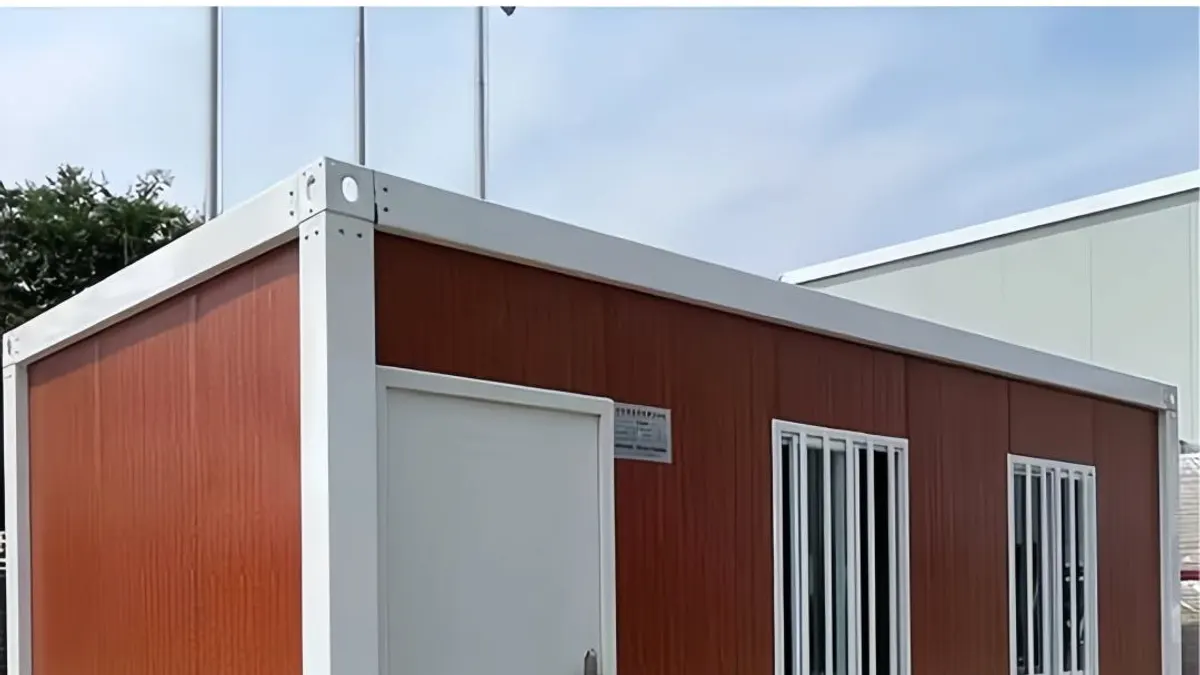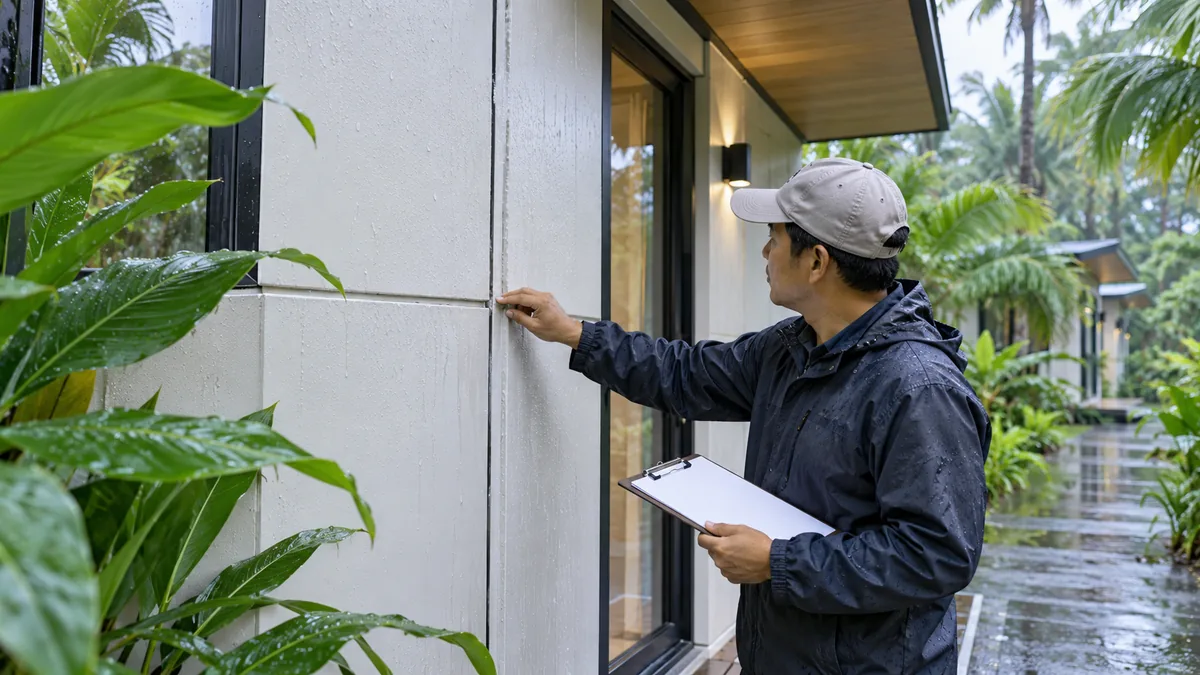
Cover: an AI-generated editorial concept, not a photograph of a completed project or evidence of technical approval.
Moisture findings can be lost between handovers
A modular guest cabin passes through several teams before opening. The factory releases it, a carrier moves it, a receiving team stores it, installers close site interfaces, and an operator takes charge. Each team may see a finished room and assume the previous team settled every moisture question.
For a hospitality project in Southeast Asia, that assumption deserves attention before procurement. A clean interior on arrival does not describe the condition of a concealed joint, explain a damaged cover, or identify who will review an unresolved water exposure. The buyer needs continuity between records as well as continuity between building components.
The four gates proposed here are factory release, arrival and temporary storage, site closure before concealment, and operational handover before opening. Each asks three questions: what has been checked, what remains uncertain, and who may accept the next stage? This is an editorial decision tool for a project team to adapt. It does not describe an existing MK Mobile House certification or guarantee that every cabin has passed the same tests.
The Southeast Asia guest-room planning guide and monsoon and island support-unit guide explain the operating and site context. Here, the focus is on the records each team needs to pass to the next.
Separate rainwater, construction moisture and condensation
Start a finding with the observed condition rather than a guessed cause. Water beside a service opening might be associated with exposure during unloading, an incomplete site connection, or condensation. Similar-looking marks do not establish the same mechanism, and a suitable response depends on the actual assembly and event.
The U.S. Environmental Protection Agency's December 2013 guidance discusses liquid water, condensation and material vulnerability across design, construction and maintenance. It is guidance rather than a code or standard, and it expressly excludes flood-water control. Its principles provide context, while destination requirements and project professionals govern the cabin's acceptance. EPA guidance.
In the project record, keep three categories separate: external water exposure, moisture associated with materials or construction work, and suspected condensation during operation. Record the location and conditions without declaring a diagnosis that nobody has verified. A factory image of a dry finish is useful evidence of that visible surface at that time; it cannot establish the later condition of an inaccessible cavity. Mark inaccessible areas explicitly so silence cannot become an implied inspection.
Agree on project-specific evidence before production
The buyer should arrange a short evidence workshop with the supplier, local designers, installation lead and operator before production drawings are frozen. Identify interfaces that will become difficult to inspect, the expected exposure during transport and storage, and the evidence required before each can be accepted. Assign acceptance criteria to an approved project document and revision.
Distinguish observation, measurement and decision. Observation describes what someone saw and where. Measurement records a method, instrument where relevant, conditions, time and result. Acceptance is a decision by the designated reviewer against an applicable criterion. A photograph supports an observation; it does not replace every specified measurement or professional inspection.
The workshop should produce a handover schedule with a responsible person, reviewer, required record and condition that prevents progression for each item. Some details may need photographs and a signed inspection record; others may need a specified test. The responsible local professionals decide what is appropriate. Avoid applying one relative-humidity threshold, material moisture reading or testing procedure to all tropical cabins. Record the agreed sampling scope too: inspecting a sample unit should not silently become evidence that every unit was inspected.
Gate one: review the factory release record
At factory release, the question is whether the agreed factory scope is documented and ready for the next stage. Link the module identifier to the approved construction details, openings, supplied components and current drawings. Identify which moisture-related interfaces are complete and which deliberately remain for site work.
Request the inspection records agreed in the purchase scope, with dates, locations, inspector roles and any limitations. Photographs should locate the detail within the unit as well as show its condition. Where a measurement or test was specified, retain its method and acceptance basis rather than reducing the result to a green tick.
The release pack should describe shipment protection and the receiving checks to complete before that protection is removed or altered. Identify outstanding items, authorized departures from drawings, and who approved how they would be handled. A missing agreed record or an unexplained open finding can prevent release under the project's handover schedule.
Factory release records the condition and contractual scope at dispatch. It does not accept future transport exposure, site workmanship or operation. The buyer should be able to explain that boundary to the receiving team without relying on an informal phone call.
Gate two: record arrival and temporary storage
On arrival, match the physical module identifier to the dispatch pack before signing a condition record. Note arrival time, receiving location, packaging condition, visible damage and any known water-contact event. Take both context photographs and detail photographs, and retain the original file references. Distinguish an event reported by the carrier from a condition observed by the receiving inspector.
If a cover is torn or water is present, record where, when and what is accessible for inspection. Route the finding to the agreed technical reviewer. Wiping a surface or replacing packaging may be a practical immediate action, but it does not alone establish that the affected assembly is acceptable for installation or closure.
Temporary storage creates another custody period. Name the party responsible for protection, agreed checks and recording changes during that period. If a unit is moved, protection is altered, or another exposure occurs, append the event to its record. An uncertain exposure should remain visible as uncertain. Installation can then proceed on an explicit receiving decision, a defined restriction or a hold, rather than on the assumption that a delivery signature settles the technical condition.
Gate three: inspect site joints before concealment
The third gate concerns work that becomes difficult to see once installers add trim, finishes or access covers. Use the approved interface drawing to identify module-to-module joints, site penetrations and other locally completed details that require review before concealment. Their final location and construction should be traceable to the actual installed unit.
Give the installer a clear notice procedure: who must attend, which documents must be available, and who authorizes closure. Include this point in the work sequence so inspection is possible without removing completed finishes. If the agreed review was missed, the project reviewer should decide what further access or evidence is necessary; a later image of finished trim does not recreate the lost view.
Record modifications as well as workmanship. A relocated service penetration, substituted component or changed joint detail needs the relevant design review and document revision before acceptance. Link the change to affected module identifiers and review whether earlier checks remain applicable. This prevents an inspection against an obsolete drawing from being used to justify a different installed detail. Closure permission should refer to the reviewed work and its scope, not simply to the cabin's appearance.
Gate four: review the operational handover before opening
Before opening, the operator needs an intelligible account of the completed room under the approved operating arrangements. Assemble the site acceptance records, agreed equipment and control information, remaining findings and instructions for reporting an abnormal condition. The review should establish what operating conditions were represented during the agreed checks and which seasonal or occupancy conditions remain unobserved.
Ask the project team to distinguish completed acceptance from future monitoring. A room checked before guests arrive has not demonstrated every occupied-season condition. Where follow-up is agreed, state the responsible person, observation period or trigger, reporting route and response obligation. Future monitoring should not erase a defect that requires resolution before use.
The operator should receive a module-to-room cross-reference, since a guest room number may differ from its factory identifier. Demonstrate access to the service locations covered by the handover instructions and confirm who can interpret findings. An unexplained anomaly, missing agreed evidence or unusable maintenance information should reach a named decision-maker before the room is released. Opening dates are a commercial input; they are not evidence that an outstanding technical question has been resolved.
The factory/site interface and commissioning checklist addresses the wider handover of building services. Link the moisture record to those agreed inspections and identify which services each acceptance covers.
Do not confuse cooling with moisture management
The Building America Solution Center's whole-house dehumidification guide explains that cooling demand and moisture-removal demand are related but distinct, and that load calculations, equipment selection and controls matter. This is residential guidance. It cannot validate the performance of a modular resort cabin in a tropical hospitality setting. PNNL residential guide.
For procurement, translate that distinction into a documentation request. Ask the local mechanical designer what conditions and operating assumptions govern the selected system, and what evidence the project requires when installed equipment and controls are handed over. A note that the room felt cool during a visit should remain an observation, not a humidity-performance certificate.
A separate April 2024 official library record identifies David Mallay's research on humidity control and ventilation in energy-efficient homes in hot-humid climates. Only the bibliographic record and brief library description were reviewed for this article; the underlying report was unavailable, so its findings and numeric results are not used. PNNL research record. Neither source supplies a universal equipment capacity or acceptance setting for this article's four gates.
Assign ownership to an unresolved finding
An open finding needs an accountable owner even when its cause or contractual liability is still being assessed. The owner coordinates the next action; that assignment does not automatically admit responsibility for causing the condition. Distinguishing coordination from liability helps teams act while the technical and contractual questions are resolved.
Record the action, deadline or next decision point, responsible reviewer and restriction on progression. For example, a finding might allow protected storage but hold concealment pending review. The reviewer should determine restrictions for the actual condition; the article does not prescribe a universal response to a wet arrival.
Closure needs a chain: original finding, agreed action, evidence of completion, reinspection where required, and recorded acceptance by the authorized reviewer. Keep earlier photographs and entries so the history is understandable. If the issue recurs, reopen or link a new finding rather than overwriting the closed one.
A buyer comparing quotations can ask who provides this coordination and which review activities are included. Record production, carrier, installation, inspection and operator responsibilities separately, then name the person who resolves a gap between them. “All parties to coordinate” leaves the next action unowned.
Build a record that follows the unit
A usable record can be simple. The essential feature is a stable module identifier linking events and evidence across custody changes. Keep the original identifier when the unit receives a site position or room number, and show both in the handover index.
Each finding should contain the handover stage, timestamp and time zone, exact location, observer, observed condition, measurement details if applicable, evidence references, governing document revision, person responsible for action, next step and acceptance status. Mark a measurement as not taken when appropriate; a blank cell should not invite a reviewer to assume a satisfactory result.
Separate the live finding register from its referenced evidence without breaking the links. Agree file naming, access rights and the handover format in advance so the operator can open the pack after the construction team's shared workspace closes. Preserve superseded drawings as history while clearly identifying the current version.
The buyer should test retrieval with a specific question: can someone find the arrival observation, site change and closure decision for one joint in one cabin? A large photo folder without location, date or unit references may answer none of them. Traceability depends on those connections, not the size of the submission.
Compare two handovers with the same-looking finish
Consider two hypothetical handovers for comparable resort cabins. These are editorial examples, not MK projects, measured trials or evidence of a particular outcome. Both rooms have neat finishes and appear ready in their final photographs.
The sparse pack contains a delivery signature and a message saying “checked and dry.” It does not identify the inspected location, inspection time, drawing revision or person who reviewed a damaged cover. The buyer cannot tell whether an inaccessible area was excluded, whether exposure occurred later, or whether the site installer changed the relevant detail.
The traceable pack connects an identified module to a timestamped arrival observation, a referenced photograph, an assigned review action and a documented decision on how to handle the finding. Its site record links an approved detail revision to the pre-concealment inspection and closure permission. The operational handover identifies what was accepted and any agreed follow-up.
The difference is the ability to investigate and make a supported acceptance decision. It does not prove that the second cabin will never develop moisture problems, or establish a saving, failure rate or health result. When comparing offers, ask for the proposed record structure and scope before treating “inspection included” as an equivalent service. Similar finishes can conceal a substantial difference in the information available to the buyer.
Keep maintenance access and inspection instructions usable
A record earns its place in operations when staff can use it to find the relevant detail and contact the right person. Link inspection instructions to recognizable locations, approved access arrangements and the room's equipment information. Explain which observations the operating team should record and which questions require a qualified technical review.
Keep the first handover pack available when a later repair or alteration occurs. When a component is replaced or a new penetration is added, update the relevant drawing, instructions and finding history through the agreed change process. Otherwise, an operator may inspect yesterday's detail using instructions for a component that is no longer installed.
For a cabin inquiry, share the destination climate information, intended operating pattern, reviewed construction requirements, likely shipment and storage exposure, and the local teams expected to accept site work. Discuss which agreed factory records and protection documents the supplier can provide. Local design, inspection, installation and long-term operation remain responsibilities to allocate under the actual contract and destination requirements. The useful procurement outcome is a record that remains accessible through all four handovers and leaves every unresolved question with a visible next action and a contact who can follow it up.
Sources
Sources checked on October 12, 2026 for an article dated October 11. The documents and the residential guide's stated update date predate the article date. The sources provide general context; this article reports no new October 12 development.
- U.S. Environmental Protection Agency: Moisture Control Guidance for Building Design, Construction and Maintenance, December 2013. Official text reviewed for moisture principles and design/construction/maintenance scope. Guidance, not code or standard; flood-water control excluded.
- Pacific Northwest National Laboratory, Building America Solution Center: Whole-House Dehumidification, last updated February 28, 2018. Residential guide reviewed for the distinction between cooling and moisture removal and project design context. No universal hospitality threshold or sizing rule is inferred.
- Building America Solution Center: Advanced HVAC Humidity Control for Hot-Humid Climates, David Mallay, U.S. Department of Energy, April 2024. Bibliographic record and brief library description only; the underlying report was unavailable, and its findings and numeric results were not reviewed or used.
The four gates, fields, procurement questions and hypothetical comparison are original editorial analysis. They are not mandatory forms from these sources or evidence of an existing supplier inspection programme.