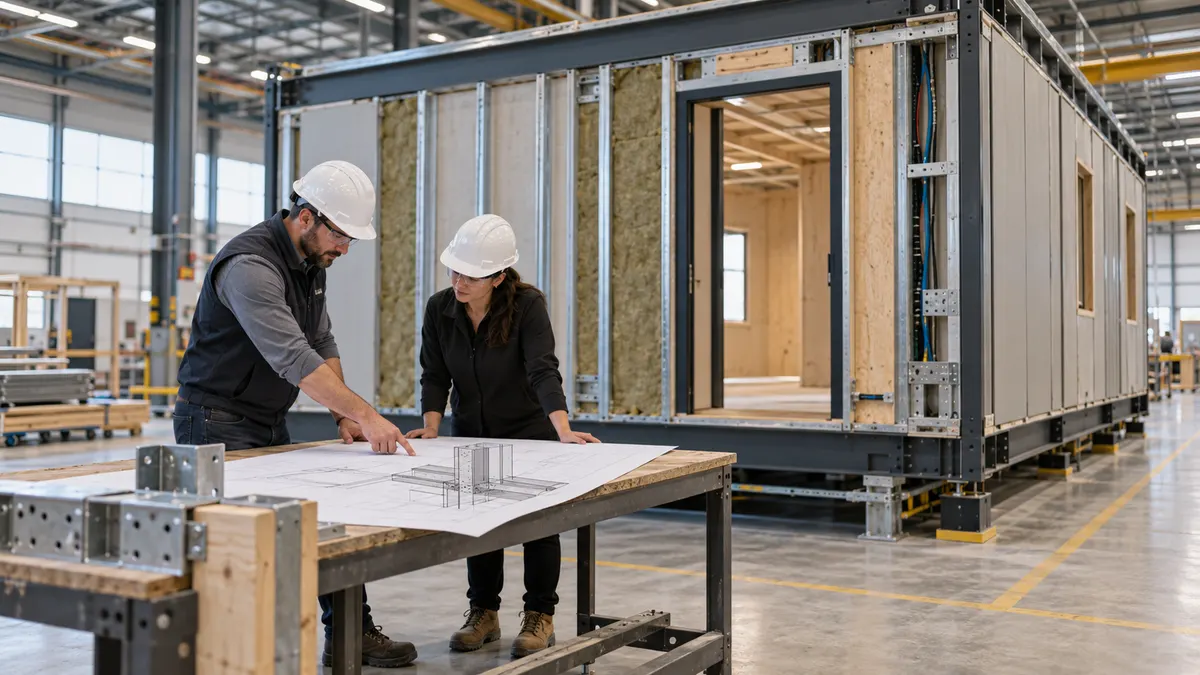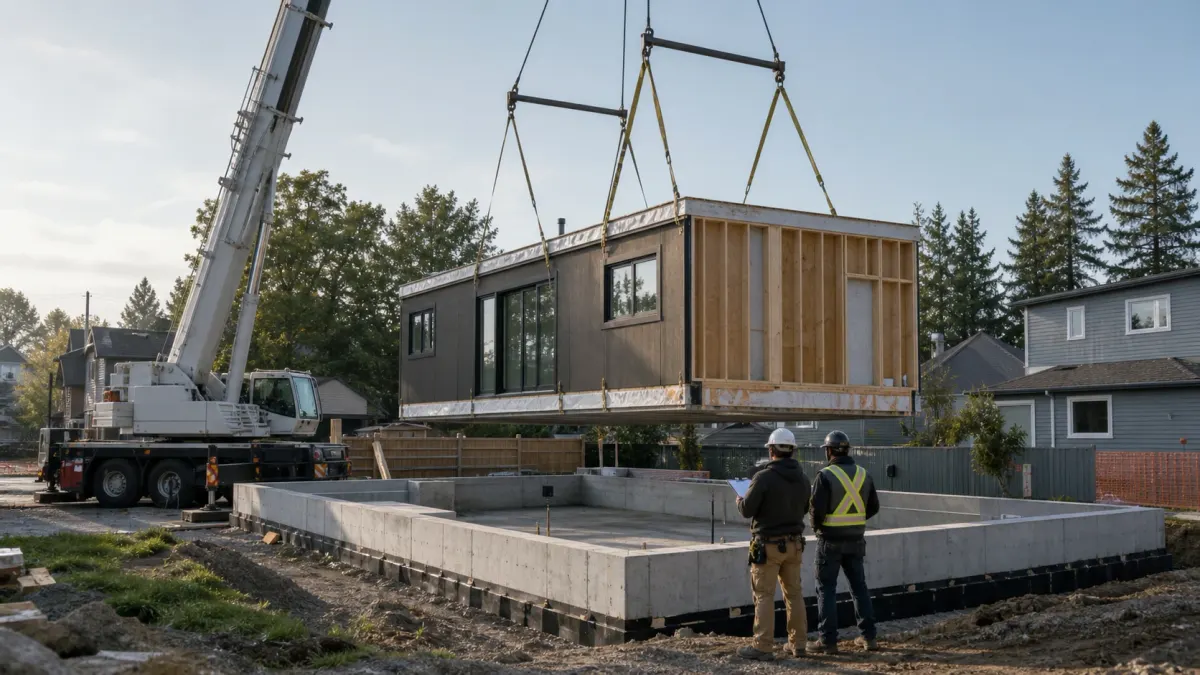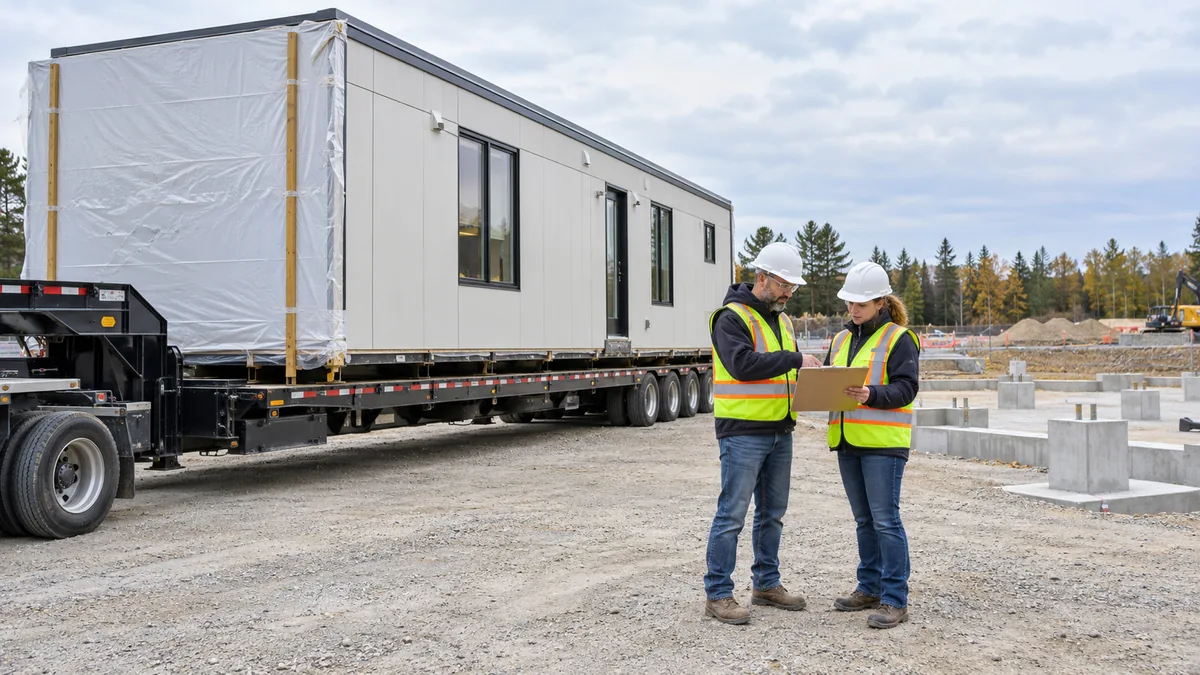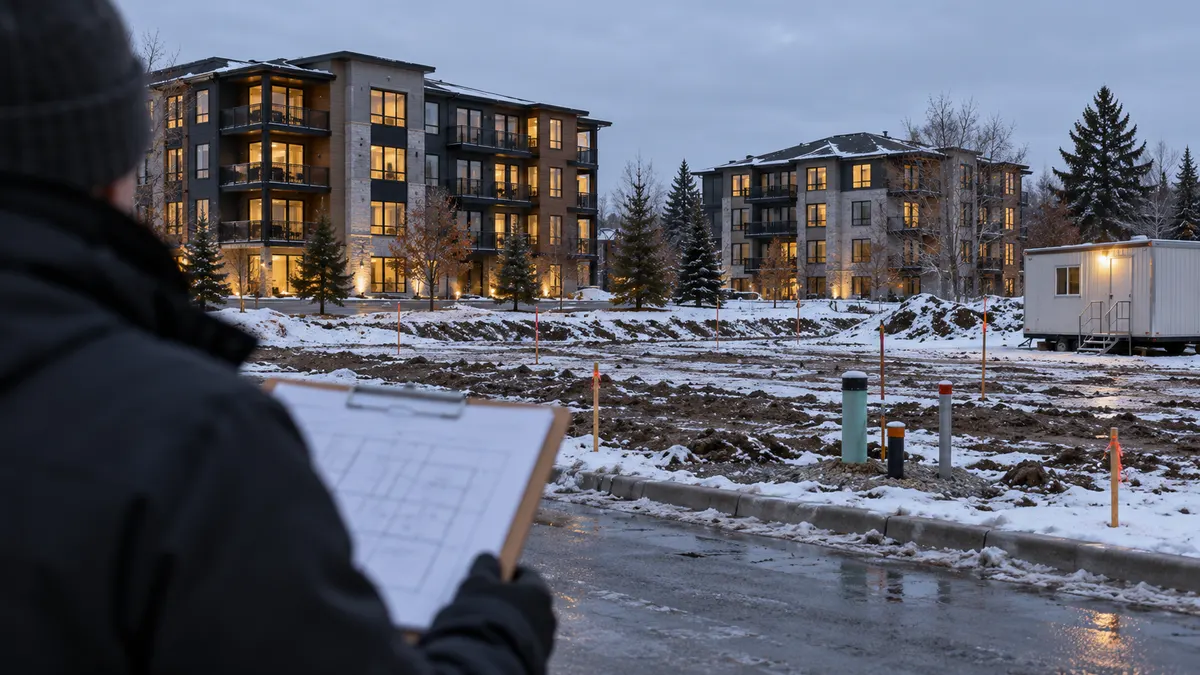
The cover is an AI-generated editorial concept, not a photograph of a completed project or evidence of a regulatory approval.
A record number with a narrow meaning
On 16 October 2026, Canada Mortgage and Housing Corporation reported that the number of units with approved building permits but not yet started had risen 1.1 per cent month over month to 143,929 in centres of 50,000 or more. The same release recorded a six-month trend of 250,411 starts, a 0.6 per cent increase that the agency described as flat, and actual September starts of 19,984 in centres of 10,000 or more, down 11 per cent from 22,375 a year earlier.
Those numbers are often summarised as a backlog of homes waiting to be built. That summary is directionally useful and analytically dangerous. The 143,929 count covers every construction method in the covered centres. It does not say how many projects are modular, how many are mid-rise concrete, how many are wood-frame low-rise, or how many will never proceed in their current form.
The more useful question for a modular supplier is narrower. Given a specific permitted project that has not started, what is actually holding it, and could a factory-built approach change that constraint? Answering it requires separating four states that are routinely blended together.
Approved, started and delivered are three different states
A building permit is evidence that a proposed design has passed a defined regulatory review. It is not evidence that construction has begun. A start, in the statistical sense, usually means that excavation or foundation work has reached a defined point. Delivery is a later state again: the building exists, has been inspected, and can be occupied.
Between those states sit decisions that no permit can make for the owner. Finance must close. Site services must be available or scheduled. A contractor or construction manager must be appointed. Insurance must be in place. Access, staging and lifting must be workable. In many projects, one unresolved item is enough to keep a permitted project in the unstarted count for months.
This matters because modular delivery changes the timing of work, not the sequence of decisions. Factory production can compress the on-site programme, but it also pulls spending forward. A project that cannot fund site work may find it even harder to fund factory progress payments. A project that has not resolved its servicing strategy can still receive modules and then sit with them.
Why permitted projects can stay unstarted
There is no single cause, and the published data does not identify one. A disciplined review tests a short list of plausible constraints without assuming which applies.
The first is sales or occupancy absorption. In a softening market, a developer may hold a permitted project because presales or lease commitments have not reached the threshold its lender requires. The second is construction cost and pro forma viability: a permitted design can become uneconomic when financing costs, materials or labour move. The third is servicing: water, sanitary, storm, power or road capacity may not be available on the assumed timetable. The fourth is approval conditions that require further design work, studies or agreements before a start is permitted.
Two further constraints are specific to factory-built supply. The first is standardisation: a project designed as a one-off may not have enough repeated units to justify tooling, jigs or a stable production line. The second is transport and installation: a design that is buildable on site may not fit a route, a crane plan or a staging area.
None of these constraints is proved by the national figure. Each has to be tested at project level, with documents rather than impressions.
Screen a project before proposing a factory route
A screening conversation should begin with the permit and its conditions, not with a product catalogue. The permit set shows what has been approved. The conditions show what remains. Together they indicate whether the project is waiting on design, on servicing, on finance or on an external party.
The second screen is site control. Does the owner control the land, the access route and the staging area for the assumed delivery period? A permitted project on land that is subject to a closing condition, a lease negotiation or a boundary dispute is not a reliable production candidate, regardless of how suitable the building type looks.
The third screen is the demand evidence the owner is actually using. If the project depends on presales, ask what threshold triggers a start and how close the project is to it. If it depends on a funding programme, ask which approval stage has been reached. If it depends on an anchor tenant, ask whether that commitment is signed.
Only after those screens should the conversation turn to construction method. A factory route is a way of delivering a project that has a decision, a site and a funding path. It is not a substitute for any of them.
Separate the building decision from the funding decision
Modular projects fail quietly when two decisions are treated as one. The building decision covers layout, performance, specification, transport configuration and installation method. The funding decision covers who commits capital, when, against what evidence, and what happens if a milestone slips.
In a conventional project, the lender's inspector sees progress on land. In a factory-built project, a large share of the value is created before the building is fixed to the land. That timing difference is exactly why progress evidence matters, and it is why a lender may impose conditions that a buyer has not anticipated.
The practical consequence is that the funding path should be mapped before the production schedule is fixed. If a lender requires a completed foundation before releasing factory funds, the foundation becomes a predecessor to production, not a parallel activity. If an insurer requires a defined inspection regime, that regime becomes part of the factory quality plan. If a funding programme requires a particular procurement route, the contract structure must reflect it from the start.
This is a planning discipline, not a claim about any specific lender's policy. The point is that the project should discover its own funding conditions early, in writing, rather than after a production slot has been reserved.
Define what "modular-ready" must mean for this project
"Modular-ready" is not a universal certificate. For a given project it should mean a set of specific, checkable conditions. A useful definition has five parts.
First, the unit or room types must repeat enough to justify a production approach. A project with forty identical studio units is a different proposition from one with forty bespoke layouts. Second, the design must fit a transport envelope that has been checked against an actual route, not an assumed one. Third, the site must be able to receive, lift and connect the modules on the planned dates. Fourth, the local professional team must have accepted the interface responsibilities between factory work and site work. Fifth, the evidence required by the authority having jurisdiction must be identified and assigned.
Each part can be evidenced. A repetition schedule, a route survey, a lifting plan, a responsibility matrix and an authority checklist are all reviewable documents. A statement that the project is "modular-friendly" is not.
The definition should also record what is explicitly out of scope. If the factory is not providing foundations, utilities or final connections, the project plan must say so, with the responsible party named. Ambiguity at this boundary is a common source of delay.
Test factory capacity against the actual release plan
A factory schedule is not a promise of capacity. It is a plan built on assumptions about design release, material lead times, labour, inspection and transport. Those assumptions should be tested against the project's own decision calendar.
Start with the release plan. When does the project need the first modules, and what must be true before that date? Work backwards through transport, factory completion, inspection, material procurement and design freeze. If the resulting dates fall before the project expects to close finance or complete foundations, the schedule is not credible.
Then test the batch logic. A single large order may secure a better unit price but commits the project to a configuration before later decisions are made. A staged order reduces that exposure but may increase setup and mobilisation costs. Neither choice is universally right; the project should choose deliberately and record why.
Finally, test the stop conditions. What happens if a batch is delayed, a design change is requested, or a site is not ready? A factory plan that has no defined hold points and no consequence for missing them is a wish, not a schedule.
Plan the site works that must precede modules
Factory completion does not create a place to put the modules. The site works that precede delivery are frequently the critical path, and they are frequently the part a buyer has least control over.
The first group is ground and structure: excavation, foundations, slabs, anchor points and any retaining or drainage work. The second is services: water, sanitary, storm, power, communications and any heating or cooling infrastructure that must reach the module connection points. The third is access: road geometry, gate width, turning radii, ground bearing capacity and the crane or lifting position. The fourth is enabling works: fencing, security, staging, site offices and welfare facilities for the installation team.
Each of these should have a named owner and a readiness date that precedes the delivery date by a margin the project defines. The margin should reflect the consequence of failure, not optimism. A missing connection can strand a completed module on a truck or on blocking, and the cost of that delay is usually borne by the party with the least leverage.
This is also where the existing delivery and lifting guidance becomes relevant. Route surveys, lifting plans and site readiness checks are not paperwork; they are the evidence that the factory date can be met.
Use a start-readiness gate with named owners
A start-readiness gate is a short, written checkpoint that a project must pass before it commits to production. It should be specific enough that a reasonable third party could audit it.
The gate should list the conditions, the evidence for each, the owner, the date and the consequence of failure. Typical conditions include: permit conditions discharged or formally addressed; finance documents executed; site control confirmed; foundations and services on schedule; access and lifting plan approved; design freeze recorded; and the authority's evidence requirements assigned.
The gate should also record what is deliberately deferred and why. Deferral is not automatically a failure; unrecorded deferral is. A project that knowingly accepts a risk, with an owner and a mitigation, is in a different position from one that has not noticed the risk.
Finally, the gate should have a review cadence. A single approval at the start of a long project is not enough. Conditions change, costs move and sites slip. A monthly review with a written status keeps the gate meaningful.
Work through a hypothetical 40-unit phase
Consider a hypothetical forty-unit residential phase in a Canadian city. The project has a permit, a site, and a lender. It has not started. The owner wants to know whether modular delivery can accelerate it. No prices, timelines or approvals in this example are real; the numbers exist only to make the decision structure visible.
The first review finds that the permit has two outstanding conditions relating to servicing. Neither is a design problem, but both require agreements with a utility. The project is therefore waiting on servicing, not on a supplier.
The second review finds that the lender requires a completed foundation before releasing the majority of construction funds. That condition makes the foundation a predecessor to factory production, not a parallel task.
The third review finds that the unit mix contains six distinct layouts across forty units, with three layouts used only twice. A production approach is possible, but the repetition is weaker than the headline unit count suggests.
The fourth review finds that the access road can carry a delivery vehicle but the turning area is tight, and the crane position conflicts with a temporary site office. These are solvable, but they must be solved before a delivery date is fixed.
The gate decision in this hypothetical is "condition", not "proceed". The project can move toward a factory route once the servicing agreements are executed, the foundation sequence is confirmed, the layout family is simplified or priced for its variation, and the access plan is revised. Each condition has an owner and a review date.
Decide: proceed, re-sequence, hold or re-procure
Four decisions are usually available, and naming them prevents a vague "let's keep talking" outcome.
Proceed means the gate conditions are met and the project commits to a production slot. Re-sequence means the project continues but changes the order of work, for example by completing foundations and services before factory release, or by starting with a smaller pilot batch. Hold means the project pauses deliberately, with a review date and a named owner, because a material condition is unresolved. Re-procure means the current delivery approach is abandoned, typically because the constraint is structural rather than temporary.
Each decision should be recorded with its evidence and its reversal cost. A hold that lasts six months may be more expensive than a re-sequence decided early. A re-procure may be right when the design cannot be standardised, but wrong when the only problem is a missing utility agreement.
The matrix matters because it forces the project to distinguish a supplier problem from a project problem. Most unstarted projects are not waiting for a better cabin; they are waiting for a decision that only the owner, lender or authority can make.
What to bring to a first supplier conversation
A productive first conversation is short and specific. Bring the current permit set and its conditions. Bring the site plan, the access route and any transport or lifting constraints already known. Bring the unit or room schedule, including repetition and variation. Bring the funding structure at the level of milestones, not confidential terms. Bring the local professional team's names and the authority having jurisdiction.
With those documents, a supplier can say something useful: which parts of the project fit a factory approach, which parts need more design work, and what evidence would be needed before a production date could be offered. Without them, the conversation tends to produce a catalogue price and an optimistic lead time, neither of which is a plan.
The final point is a caution about the national figure. The 143,929 permitted-but-unstarted units are a real signal about the housing market. They are not a modular market, and they are not a list of available projects. The value of the number is that it invites better questions at project level, where the actual decisions are made.
Sources
- Canada Mortgage and Housing Corporation, "Housing starts and construction data for September 2026", 16 October 2026. https://www.newswire.ca/news-releases/housing-starts-and-construction-data-for-september-2026-800196207.html
Source note: the release reports national and major-centre aggregates. It does not identify individual projects, construction methods or the reasons a permitted unit has not started. Figures are as published on 16 October 2026; later revisions are not reflected here. Quoted commentary is attributed to Aled ab Iorwerth, Deputy Chief Economist at CMHC, as published in the release. The screening framework, hypothetical phase and decision matrix are original editorial analysis, not CMHC guidance.