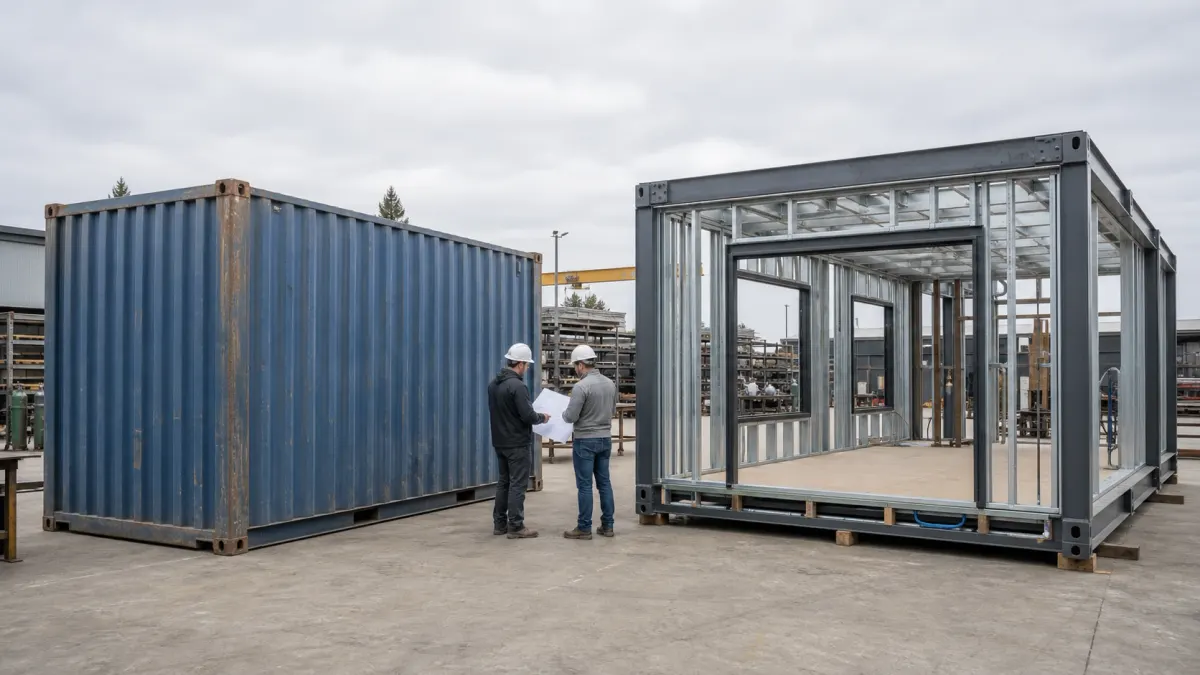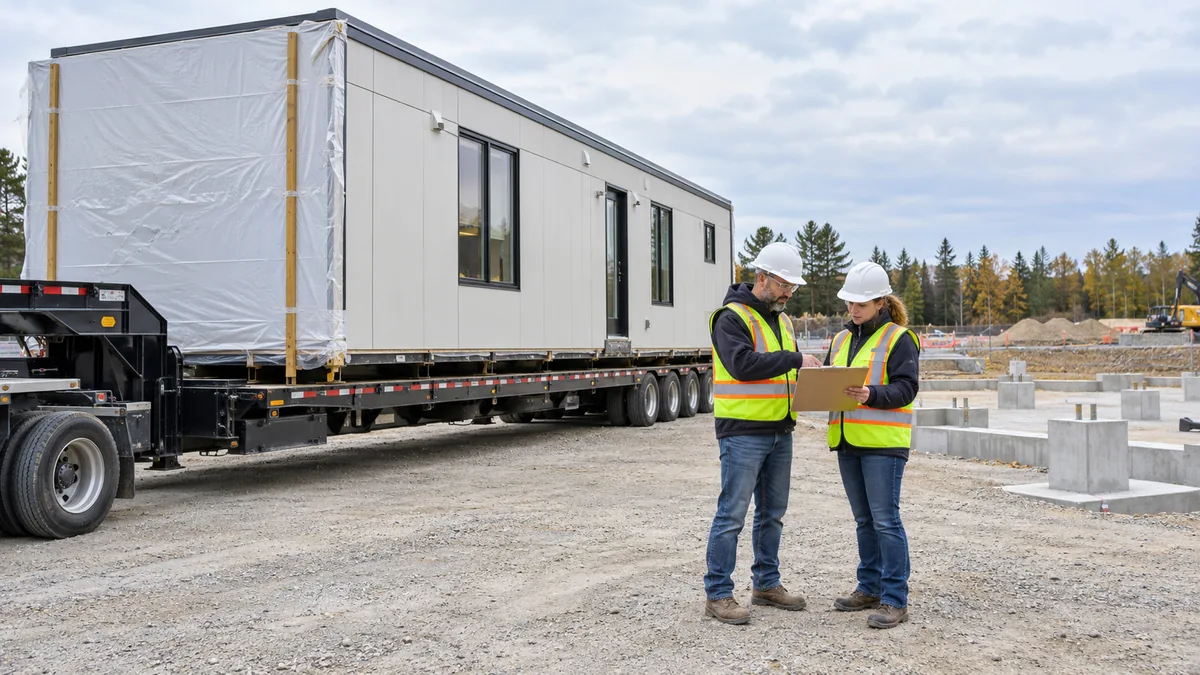
Cover: an AI-generated editorial concept, not a photograph of a completed project or evidence of technical approval.
Factory completion is only one release decision
A finished modular room can be ready to leave the production line while its destination remains unable to receive it. The factory has completed one scope; the carrier, receiving site and lifting team have different questions to close. A photograph of finished interiors answers none of those questions.
For an imported module going to a US project, organize release around the particular unit, shipment and plot. Factory quality acceptance establishes the agreed supply condition. Transport review establishes how the actual shipment can move. Site readiness establishes whether the receiving team can execute the agreed handoff. Record each decision separately, with its owner and evidence.
This article develops the pre-dispatch decision beyond the broader local installer coordination brief. Its workflow is an editorial planning tool, not a regulatory release form. The US sources cited apply within their respective US scopes; they do not establish Canadian or worldwide requirements. Responsibilities and acceptance authority must be agreed in the project documents before a shipping date becomes a commitment.
Freeze the transport configuration and revision
The useful dimensions are those of the unit as transported, including its specified protection and attached items. An expanded floor area, occupied-room drawing or catalogue envelope can describe a different state. A detachable canopy, loose equipment package or changed cladding detail may alter the shipment even when the model name stays the same.
Give the factory and carrier a configuration record that identifies each module, drawing revision, transport envelope, documented weight and the basis of that weight. Distinguish measured information from engineering estimates and identify who resolves any remaining uncertainty. Record what is attached, removed, packaged separately or temporarily secured, with matching photographs and packing references.
The carrier needs the data relevant to the selected vehicle and load arrangement, rather than a building weight with no explanation of what it includes. The handling team needs information about the load it will receive. Both should acknowledge the same configuration. If the factory changes an item after that acknowledgement, issue a controlled revision and obtain the affected reviews again. The shipping-container and purpose-built module comparison explains why a commercial label cannot stand in for the actual structure.
Review the route with the actual carrier
“Delivery to the port” leaves a substantial part of the journey undefined. Ask the actual inland carrier to review the route from the agreed collection point to the receiving position, using the current shipment configuration and intended vehicle. Include terminal access, transfer arrangements and the final approach inside the property.
The review should identify unresolved restrictions, access permissions, roadworks, overhead constraints, gate arrangements and places where the vehicle could wait without obstructing other work. A mapped line or photographs from an earlier shipment are background information; the carrier should state what has been checked for this movement and what still needs confirmation.
Assign an owner to the last segment. A public-road route can end at a gate that the loaded vehicle cannot use as assumed, or at an entrance occupied by another contractor. Agree who provides current site access information and who authorizes changes. The deliverable is a dated carrier review tied to a configuration revision, a named destination and the expected movement window. An unresolved final approach belongs in the release decision, even when ocean freight is already booked.
Separate movement permits from building approval
The US Federal Highway Administration explains that the federal government does not issue oversize or overweight vehicle permits; state permitting arrangements apply. Its page directs applicants to the states through which they intend to travel. This supports route-specific review, not a claim that a module already has permission to move. FHWA permit guidance.
Ask the carrier or assigned permitting professional to identify required permissions, their status and any conditions affecting the planned journey. “Application submitted” and “permission issued for this movement” are different entries. Where timing or routing conditions remain open, show them beside the dispatch window and identify who verifies closure.
Keep this record separate from customs entry, building approval and site inspection. A road movement permission does not approve the building's use, foundation or services. Equally, a building approval does not resolve a carrier's route. The landed-cost assumptions article covers commercial and import responsibilities; the additional question here is whether each movement permission matches the current goods, vehicle arrangement and journey. Do not copy a previous project's answer without review.
Prepare the module handling information
The module supplier should identify the handling information it can provide and the engineering input needed beyond its supply scope. Ask for documentation applicable to the exact unit: load identification, weight basis, relevant structural and handling information, limitations, protection requirements and the condition in which the unit may be transferred or temporarily stored. A generic diagram with no revision or unit reference is difficult to reconcile with the delivered load.
Keep the responsibilities for cargo packing, transport restraint and site lifting visible. The 2014 Code of Practice for Packing of Cargo Transport Units was developed by the International Maritime Organization, International Labour Organization and United Nations Economic Commission for Europe. It provides nonmandatory global guidance on packing and handling cargo transport units for sea and land transport. It can inform an applicable packing arrangement; it does not certify a building module's lifting provisions. Official code overview.
If a supplier's document is incomplete for the proposed handling method, identify the required reviewer before release. Do not infer a lifting method or container certification from a product name, corner-like fitting or container-shaped appearance. Close the information gap through the responsible engineering and handling parties.
Confirm responsibility for lift planning
Name the qualified local lifting provider and identify any engineering review required by the project or applicable rules, with a responsible professional for that scope. Give them the current module information and actual site layout before they confirm their arrangements. The buyer coordinates delivery of those inputs; a factory sales contact cannot replace local equipment selection and site assessment. The planning record should reflect the work's actual requirements rather than assume one universal form of engineered lifting plan.
The US construction crane operation rule addresses equipment manufacturer procedures, accessible operating information and environmental effects on equipment. It assigns adjustments for wind, ice and snow to the competent person. The employer and responsible professionals must establish the rule's applicability and fulfill the duties assigned to their roles. US construction crane operation rule.
A buyer's acceptance record can identify the plan revision, responsible reviewer, equipment arrangement, required site conditions and unresolved interfaces without attempting to calculate the lift. A crane advertisement's headline capacity cannot establish suitability for the proposed placement. Leave equipment capacity, operating geometry, lifting accessories and weather limits to the qualified team using the specific load, equipment and engineering information. Also identify who can stop the operation when actual conditions differ, and who communicates that decision to the carrier and site coordinator.
Review the set-up area and underground information
A completed foundation is evidence about the building support scope; it does not establish that the crane set-up area or loaded vehicle approach is ready. These areas may occupy different ground, include recent trenches or sit above known buried structures. A clean-looking surface cannot close those questions.
The US construction crane ground-conditions rule addresses support suited to the equipment manufacturer's requirements. It assigns ground preparation duties to the controlling entity and requires it to inform the equipment user and operator about hazards beneath the set-up area that it knows of or that appear in documents it holds. Where there is no controlling entity, the employer with authority to make or arrange the required ground preparations must fulfill that preparation duty. Ground conditions, §1926.1402.
Have the responsible site party identify the applicable role and supply current ground and underground information to the lifting provider. Record who reviews it, who arranges required preparation and what confirms completion. Site drawings, known utilities and recent excavation changes should reach the relevant team before equipment arrives. The buyer should seek an explicit readiness response for the agreed set-up area, rather than interpreting “site cleared” as technical acceptance. Any required assessment or preparation remains the work of the responsible site professionals.
Coordinate foundations, access and placement sequence
Review delivery order against the receiving layout. Placing one unit can remove access needed for the next; completing a trench or fence can change the vehicle approach. The foundation team should provide its required completion and acceptance evidence, while the placement team confirms that the current layout supports its sequence. Neither should rely on an earlier general site plan.
Consider two hypothetical planning cases, not reports of MK projects. A buyer selects finished volumetric rooms to transfer more assembly work to the factory. The team then discovers that the selected receiving arrangement cannot accommodate the shipment as proposed. Its choices require professional review: revise access, change transport or handling arrangements, change product configuration, or pause procurement.
Another buyer selects compact component packages for site assembly. Their shipment arrangement may change the transport problem, but the receiving plan must now account for assembly space, component identification, protection, local labour and inspection sequencing. Compact packaging does not prove a simpler whole project. These cases illustrate different interfaces, without assuming time or cost savings. Compare alternatives using actual carrier and local execution proposals before freezing the order.
Agree on receiving windows, weather checks and changes
Work backward from an agreed receiving window, allowing for the necessary transport and site reviews. Identify who confirms the window, when the carrier needs notice and where the cargo may go if direct placement is unavailable. Agree when the lifting team will assess the forecast and actual site conditions against its equipment procedures and project requirements. A shipping date does not override that team's decision to postpone an operation. A possible storage location requires an agreed handling and protection arrangement, access permission and a responsible custodian; “leave it nearby” leaves these matters unresolved.
Record delay consequences commercially, including waiting, rebooking, temporary storage, protection and any repeat inspection. Allocate responsibility under the contract without presuming that every weather delay or site change belongs to the same party. Set an escalation contact who can assemble a decision when factory, carrier and local teams disagree about readiness.
Change control should cover module configuration, vehicle, route, receiving plot, set-up area and placement sequence. Each change notice identifies the superseded record, affected reviews and the decision needed before proceeding. If a site contractor moves a stockpile into the agreed approach, the carrier and placement team need the updated facts even though production is unchanged. A date remains provisional while the evidence supporting it is no longer current.
Use a dispatch, hold or replan matrix
Use a short decision sheet to connect readiness evidence with action. The following matrix is an editorial coordination example; the contract and project procedures must name the people authorized to release shipment and accept exceptions. The sheet records decisions made through the required permit, inspection and professional review processes; it does not replace those processes.
| Discussion outcome | Concrete evidence to record | Coordination action |
|---|---|---|
| Dispatch | Factory release identifies the unit and configuration; carrier review and required movement permissions match; local lifting and site parties confirm their agreed inputs and receiving window | Authorized owner records release, references accepted documents and communicates the same shipment details to all parties |
| Hold | Current configuration is unchanged, but a required handling document, permission confirmation or site preparation acceptance remains open | Record the missing item, closure owner and deadline; retain the shipment at the agreed location until the required decision is made |
| Replan | Configuration changes, access becomes unavailable, set-up area moves or the receiving sequence no longer matches the reviewed arrangement | Issue revised inputs, identify affected permissions and professional reviews, and obtain a new receiving window before reconsidering release |
“All parties informed” is not equivalent to “all required decisions closed.” A file's existence is not evidence that its responsible reviewer accepted it. Preserve the decision date and revision references so a later team can understand why dispatch proceeded or stopped.
Keep arrival acceptance separate from final commissioning
Arrival acceptance reconciles what was delivered with what was released. Identify the unit and configuration, record visible condition, reconcile loose packages and protection, and document discrepancies with photographs and notifications under the contract. Define who can sign the receiving record and what that signature acknowledges.
If damage or a mismatch affects handling, the receiving team should refer it to the responsible professionals before continuing. State the signature's scope and record unresolved defects under the contract, so an arrival receipt is not mistaken for engineering acceptance or building approval. Explain how disputed items are documented, preserved, investigated and assigned for correction.
Placement acceptance is another milestone. It records the agreed placement work and outstanding interfaces; it does not automatically demonstrate successful services, weather protection or whole-building operation. Final testing, commissioning and required authority decisions follow their own criteria. The factory/site commissioning article develops that later handoff. Linking the records by module identification preserves continuity without treating them as interchangeable. This also prevents a factory test, arrival receipt and operational handover from being described as the same acceptance.
Assemble the buyer's pre-dispatch evidence pack
Keep a concise index rather than distributing an unstructured collection of attachments. For each module or shipment, link the configuration record, factory release, packing list, carrier route review, movement permission status, handling information, local lifting review, site readiness response, receiving sequence and decision sheet. Include the revision, issuer, responsible reviewer and open-item owner beside each record.
The index should distinguish accepted documents from reference material and unresolved submissions. Archive superseded revisions where they cannot be mistaken for current instructions. Give the receiving team the version it needs before the cargo travels, and identify who issues updates across time zones. A shared folder alone does not establish review or decision authority.
Before discussing supply with MK Mobile House, provide the project location, intended delivery configuration, route information available and the nominated carrier and site contacts. Ask which factory and shipment records are included in the proposed scope and which require separate engineering or local services. Agree these responsibilities in the supply scope, including who provides local lifting, approvals and installation where needed. Set the shipping date once the receiving decision is current and its supporting records can be traced.
Sources
- US Federal Highway Administration: Oversize/Overweight Load Permits. State permitting context; no project-specific route permission is established.
- US Occupational Safety and Health Administration: §1926.1402, Ground conditions. Equipment support, ground preparation responsibilities and known underground hazard information within the applicable US construction scope.
- US Occupational Safety and Health Administration: §1926.1417, Operation. Equipment procedures and environmental considerations; no lifting calculation or equipment prescription is derived here.
- International Maritime Organization: 2014 cargo transport unit code overview. Nonmandatory packing and handling guidance for applicable cargo transport units; it does not certify building modules or their lifting provisions.
Sources checked on October 12, 2026. The workflow, hypothetical cases and decision matrix are original editorial analysis. No actual MK route survey, permit, lifting plan, project approval or measured saving is asserted.