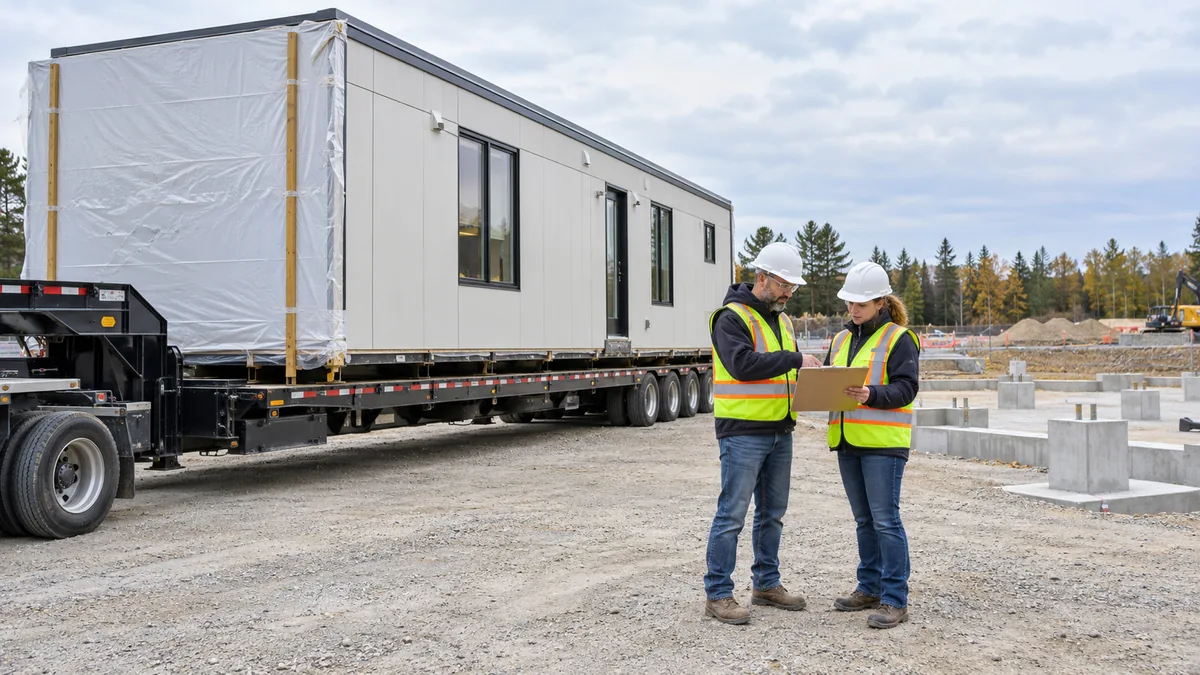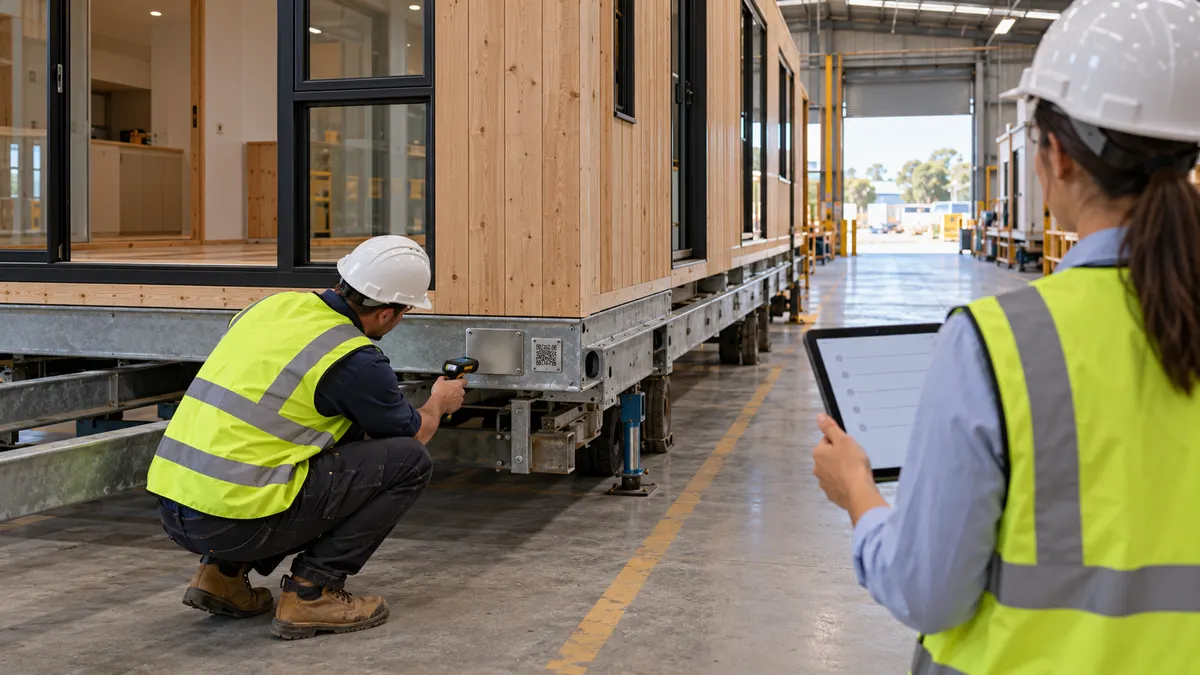
The cover is an AI-generated editorial concept, not a photograph of a completed project or evidence of a finance approval.
The gap the pilot is trying to close
On 20 October 2026, the Australian peak body for prefabricated and modular construction announced that it is backing the creation of a Building Identification Number, modelled on the vehicle identification number used in vehicle finance and insurance. The body, prefabAUS, described the work as an industry-led pilot intended to create a chain of custody and to align factory milestones with progress payments under a new standard form contract for Class 1 work.
The problem it addresses is easy to state. In conventional construction, a valuer or inspector can visit a site and see a building rising. In modular construction, much of the value is created in a factory that the valuer may never visit, weeks or months before the building is fixed to land. The evidence exists, but it is dispersed across production records, inspection sheets, photographs and delivery documents.
The pilot is a serious attempt to organise that evidence around a persistent identifier. Whether it succeeds depends on questions that an identifier alone cannot answer: who verifies each milestone, what they are verifying against, and whether the parties who rely on the record will accept it.
What a building identifier is and is not
An identifier is a name that stays with an object. A vehicle identification number stays with a car through manufacture, sale, repair and resale. A building identifier is intended to do something similar for a building or a module: give every record a stable anchor.
That is useful because records otherwise fragment. A factory may hold production data, a transporter may hold delivery notes, a site team may hold installation records, and an authority may hold inspection records. Without a shared identifier, connecting them depends on names, dates and manual cross-checking.
But an identifier is not a certificate. It does not establish that a module was built correctly, that it meets a standard, or that it is worth a particular amount. It establishes identity and, if the system is well designed, a way to find the evidence. The judgement about quality and value remains with the parties who are qualified to make it.
Nor is an identifier a title record. It can link to an address record after occupation, but it does not by itself determine ownership or create a security interest. Those are legal questions governed by other instruments.
Follow the chain of custody
A chain of custody is a sequence of transfers, each with a record of who held the item and what condition it was in. For a modular building, the sequence typically runs from component procurement through module fabrication, factory inspection, transport, site receipt, installation and handover.
At each transfer, three things should be recorded: what moved, who accepted it, and what evidence accompanied it. The identifier makes it possible to attach those records to the same object without relying on a project name that may change.
The chain is only as strong as its weakest link. A factory that records everything but hands over a module without a transport record has broken the chain. A site that receives a module without checking it against the factory record has created a gap that may only become visible when a defect appears.
For a project, the practical test is to take one module and trace it from fabrication to handover. If the trace requires more than a few minutes and several phone calls, the chain is not yet a system.
Map factory milestones to payment milestones
Progress payments depend on milestones. In a factory-built project, the milestones should be defined so that both the completed work and the evidence of completion are unambiguous.
A typical sequence might include design release, material procurement, frame completion, enclosure, services rough-in, internal finishes, factory inspection, dispatch and site installation. The exact sequence depends on the product and the contract.
For each milestone, the contract should state what must be complete, what evidence must be provided, who inspects, and what happens if the evidence is incomplete. The identifier then links the evidence to the module and to the payment claim.
The most common failure is a milestone defined by activity rather than by evidence. "Frame complete" is an activity. "Frame complete, inspected against drawing revision X, with photographs and an inspection sign-off recorded under identifier Y" is a milestone that can be paid against.
Separate progress evidence from completion evidence
Progress evidence answers a narrow question: has the work reached the defined stage? Completion evidence answers a broader question: is the building ready to be used?
The two are often confused because both involve inspection. But they serve different decisions. A lender releasing a progress payment needs to know that the value it is financing has been created. An authority issuing an occupancy approval needs to know that the completed building meets the applicable requirements.
A project that treats a progress inspection as a completion inspection may release money against work that later fails. A project that treats a completion inspection as a progress inspection may delay payments unnecessarily. The records should be labelled clearly so that neither is mistaken for the other.
Design the record before the first module
The most expensive time to design a record system is after production has started. By then, the first modules have already been built without the identifiers, photographs or sign-offs that the system assumes.
Before production, the project should decide what will be recorded, at which milestones, by whom, in what format and where it will be stored. It should also decide how revisions will be handled: if a drawing changes, which record shows that the module was built to the new revision rather than the old one?
The record design should be proportionate. A small project does not need an enterprise platform. It needs a consistent identifier, a defined milestone list, a clear sign-off and a storage location that survives staff changes. A large project may need more, but the principles are the same.
Test lender and insurer questions early
The pilot's own materials note that the test project did not require bank funding. That is an important limitation, because it means the pilot cannot by itself show how a lender would behave in a financed project.
A project that intends to rely on factory progress should therefore ask its lender and insurer early what evidence they would accept. Typical questions include: who must certify progress, whether photographs are sufficient, whether a third-party inspector is required, how retention is handled, and what happens if a module is completed but cannot be delivered.
The answers may vary by lender and by product. The project's task is not to assume an answer but to obtain one in writing before the payment structure is fixed. If the lender requires a different inspection regime, that regime should be built into the factory quality plan from the start.
Keep the identifier stable through transport and installation
The identifier is most useful when it survives the transitions that most often break records: dispatch, transport, site receipt and installation.
At dispatch, the module should be recorded with its identifier, its configuration and its condition. At site receipt, the receiving party should confirm the identifier and record any damage. At installation, the identifier should be linked to the location and to the connection records. At handover, the identifier should link to the manual, warranty and maintenance information.
If any of these steps uses a different naming convention, the chain breaks. A project should therefore agree the convention before the first dispatch and check it at each transition.
Avoid four common misreadings
Four misreadings are worth naming because they lead to bad decisions.
The first is treating the pilot as a national scheme. It is an industry-led test, not an operating requirement. The second is treating the identifier as automatic finance. It may support finance, but it does not create a lending obligation. The third is treating it as a quality certificate. It supports traceability, not a conclusion about fitness. The fourth is treating it as an ownership record. It may link to an address record, but it does not determine title.
A project that avoids these four misreadings can use the concept sensibly: as a way to organise evidence, not as a substitute for the judgements that evidence supports.
Work through a hypothetical 50-home pilot
Consider a hypothetical fifty-home modular project in Victoria. The numbers and milestones are illustrative.
The project defines six payment milestones: design release, frame, enclosure, services rough-in, factory inspection and site installation. Each milestone has an evidence list, an inspector and a sign-off.
The project assigns an identifier to each module at frame completion. From that point, every inspection, photograph and transport document references the identifier. The factory keeps a register that maps each identifier to its drawing revision and inspection records.
At the first factory inspection, the inspector finds that two modules were built to an earlier revision of a services drawing. The identifier makes the discrepancy visible quickly, because the register links the module to the revision. The modules are reworked and re-inspected before dispatch.
At site receipt, one module arrives with damage to a corner. The receiving record references the identifier and attaches photographs. The damage is attributed and repaired, and the record remains with the module.
The project does not claim that the identifier improved its financing. It records that the identifier reduced the time needed to trace records and made a revision discrepancy visible earlier. That is a modest, verifiable claim, and it is the kind of claim a pilot should produce.
Use an adopt, trial, wait or decline matrix
Four decisions are available to a project considering the concept.
Adopt means the project will use a building identifier as its record anchor from the start. Trial means it will use it on a defined batch and compare the result with its existing approach. Wait means it will monitor the pilot and decide later. Decline means the cost or complexity is not justified for the project's scale.
The decision should be based on the project's own evidence burden. A project with a single module and a simple payment structure may not need a formal identifier. A project with many modules, multiple funders and a factory in another jurisdiction may find the structure valuable even before any national scheme exists.
What to prepare now
A manufacturer or buyer that wants to be ready does not need to wait for a national system. It can prepare four things: a consistent identifier convention, a milestone and evidence list, a revision-control method that links modules to drawings, and a storage arrangement that survives staff turnover.
Those four are useful regardless of whether the pilot becomes a standard. They also make a project easier to audit, which is valuable to lenders, insurers and authorities even when no identifier scheme applies.
Sources
- prefabAUS, "prefabAUS Supports the Creation of a Building Identification Number", 20 October 2026. https://www.prefabaus.org.au/news-events/constructions-kodak-moment-inside-australias-growing-modular-and-prefabricated-manufacturing-base-ezkrw
Source note: the page describes an industry-led pilot, a live fifty-home modular housing project in Victoria as the test case, RMIT University research into traceability and financing-risk management, and a working group including prefabAUS, Geoscape, GS1, Quipex, Commonwealth Bank, Better Living Group, Dulux, James Hardie and the RMIT Post Carbon Research Centre. It states that the project did not require bank funding. Corroborating coverage dated 23 October 2026 was excluded to respect this article's date. The milestone framework, hypothetical pilot and decision matrix are original editorial analysis.