Australia is moving prefab into mainstream housing policy
Australia’s 2026 housing agenda gives prefabricated and modular construction a more formal role in national housing delivery. On 28 May 2026, the Australian Government released Homes for Australia: A National Plan, a wider housing framework that identifies modern construction methods as part of the effort to increase supply.
A separate intergovernmental schedule, Advancing Prefabricated and Modular Construction, began on 19 August 2026 with total funding of A$39.3 million. It is intended to support standardisation, offsite manufacturing, a publicly available kit-of-parts system, aggregation of demand across jurisdictions, and a stronger pipeline of suppliers and manufacturers.
That is a meaningful policy signal. Modern methods of construction are being treated less as isolated pilot projects and more as part of the housing-delivery system.
For a buyer, however, the policy direction is only the beginning. It does not make a specific modular home automatically acceptable for every state, council or site. Building use, jurisdiction, design basis, supporting evidence, logistics and local approvals still have to be defined before a factory-built system becomes a buildable project.
National policy does not create one national project approval
Australia has a National Construction Code, or NCC, but there is no single national permit attached to a modular product.
The NCC provides the main technical framework for building and plumbing work. States and territories administer their own regulatory systems around that framework, including approvals, practitioner requirements and jurisdictional variations.
This becomes important when a project involves imported modules. Factory drawings, structural calculations, material specifications, test reports and production quality records may all contribute to the evidence package. They do not, on their own, establish that the finished building is suitable for a specific parcel of land.
The project may still need to address building classification, planning controls, structural design inputs, wind and climate conditions, bushfire or cyclone exposure where relevant, foundations, drainage, accessibility, fire safety, energy efficiency, utilities and the requirements of local professionals and approval authorities.
For procurement purposes, asking whether a product is simply “approved in Australia” is therefore too broad. The more useful exercise is to identify the evidence and local work required for the exact configuration and destination.
The proposed national manufacturer scheme is still under development
The Australian Building Codes Board is developing a National Voluntary Certification Scheme for Manufacturers of Prefabricated Construction.
The 2026 consultation included a proposed definition of prefabricated construction for the NCC, a certification framework, draft scheme rules and an economic analysis. Consultation opened on 14 July and closed on 15 September 2026.
As of 5 October 2026, this remains a proposed scheme rather than an operating certification system. ABCB currently indicates that commencement is being targeted for around mid-2028, with that timing still subject to further development and consultation.
That status matters when a product is marketed or specified. A manufacturer cannot presently claim that a module has been certified under this future national scheme. Project teams must continue to work with the NCC pathways and evidence that are actually available today.
The proposed scheme may eventually make repeated factory evidence easier to use across jurisdictions. Until then, a quotation or technical submission should state exactly which drawings, calculations, reports, certificates and production controls support the proposed product.
NSW is formalising responsibility across the factory-to-site chain
New South Wales is also changing the way prefabricated buildings are regulated.
The Building (Approvals and Practitioners) Act 2026 passed Parliament in August 2026. Building Commission NSW states that the reforms will commence after associated regulations have been developed, with industry consultation on those regulations continuing through 2026 and 2027.
Although the detailed regulations are not finished, the direction is unusually clear. NSW intends to integrate prefabricated buildings into the building approvals system and set clearer obligations for manufacture, supply, transport, delivery and installation. The government describes this as a chain of responsibility across the manufacturing and supply process.
That should influence procurement before the new regulations take effect.
A module passes through several technical handoffs: approved production drawings, foundation dimensions, transport protection, lifting, temporary bracing, placement, site joints, utility connections, inspection and defect correction. If responsibility for those interfaces is vague, the project may still fail even when the factory unit itself is well made.
The legislation is therefore better read as a direction of travel than as a finished compliance manual. The forthcoming regulations will determine the detailed certification, licensing and consumer-protection requirements.
Separate the factory product from the destination project
A modular procurement package becomes easier to manage when the scope is divided into three layers.
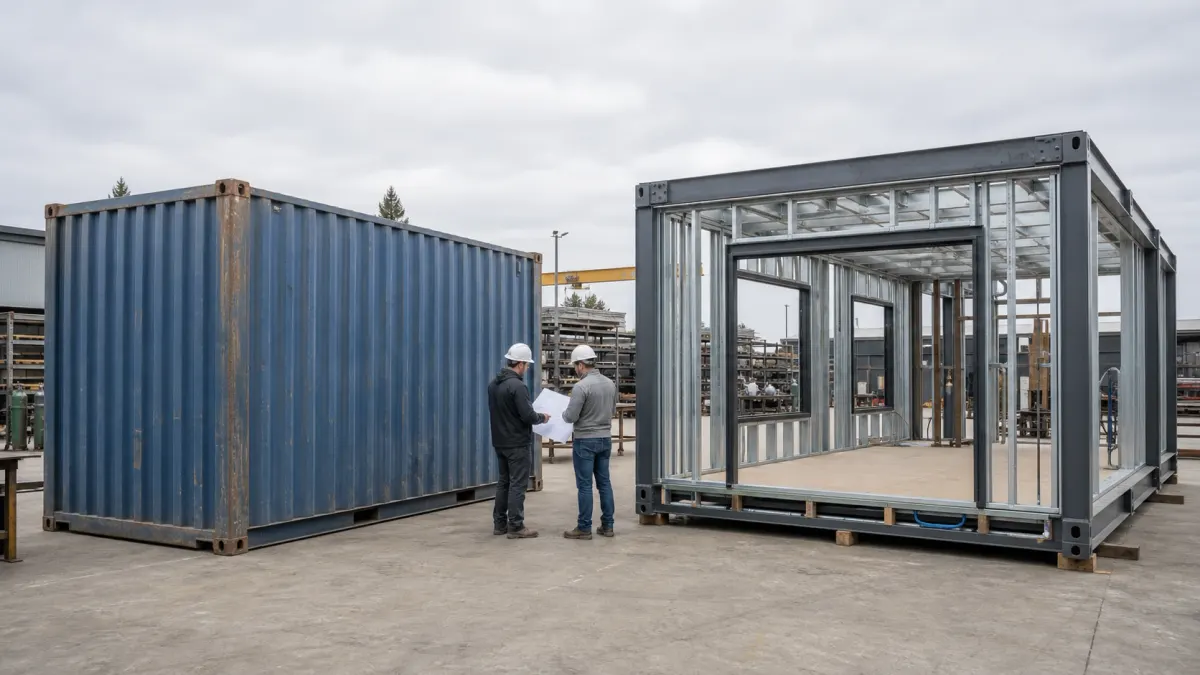
The first is the repeatable factory-built product. Depending on the system, this may include the structural frame, wall and roof assemblies, windows and doors, internal linings, fixed services, finishes and agreed equipment. The manufacturer should identify which drawings, specifications, inspections and quality records belong to that delivered configuration.
The second is the configurable product scope. Room layouts, openings, finishes, equipment, service interfaces and optional packages may change between projects. Those variations need controlled revisions so that the technical evidence still corresponds with the units placed into production.
The third is the destination-specific scope. Foundations, geotechnical input, local engineering, approval submissions, inland transport, lifting, installation, external utility connections, inspections, commissioning and final approvals commonly depend on the Australian site and the parties licensed or appointed there.
The boundary between these layers should appear in the quotation, drawings and responsibility matrix. Without that boundary, manufacturers can be asked to take responsibility for work outside their practical control, while local teams may alter important factory interfaces without updating the evidence package.
Standardisation still has to respond to local climate and site inputs
Repeatability is one of the main attractions of modern construction methods. It does not require every Australian project to use an identical technical specification.
Queensland’s government MMC program provides a useful example. Its standardised housing designs are intended for all four Queensland climatic zones and are aligned with NCC 2022 and Queensland government housing requirements. The program includes volumetric systems, flat-packed systems and kit-of-parts approaches, while reference designs are used to support early planning, budgeting, approvals and the onboarding of manufacturing partners.
The principle is relevant beyond Queensland.
A product family may retain the same structural grid, manufacturing sequence and basic service strategy while changing insulation, glazing, corrosion protection, ventilation, roof details, equipment, fixings or foundation interfaces to suit the design basis.
Those variables should be known before production release. A drawing described only as an “Australian version” is rarely enough. A useful production brief records the actual project location and the technical inputs that follow from it.
Transport limits belong in the design brief
For a factory-built project, transport is part of product design.
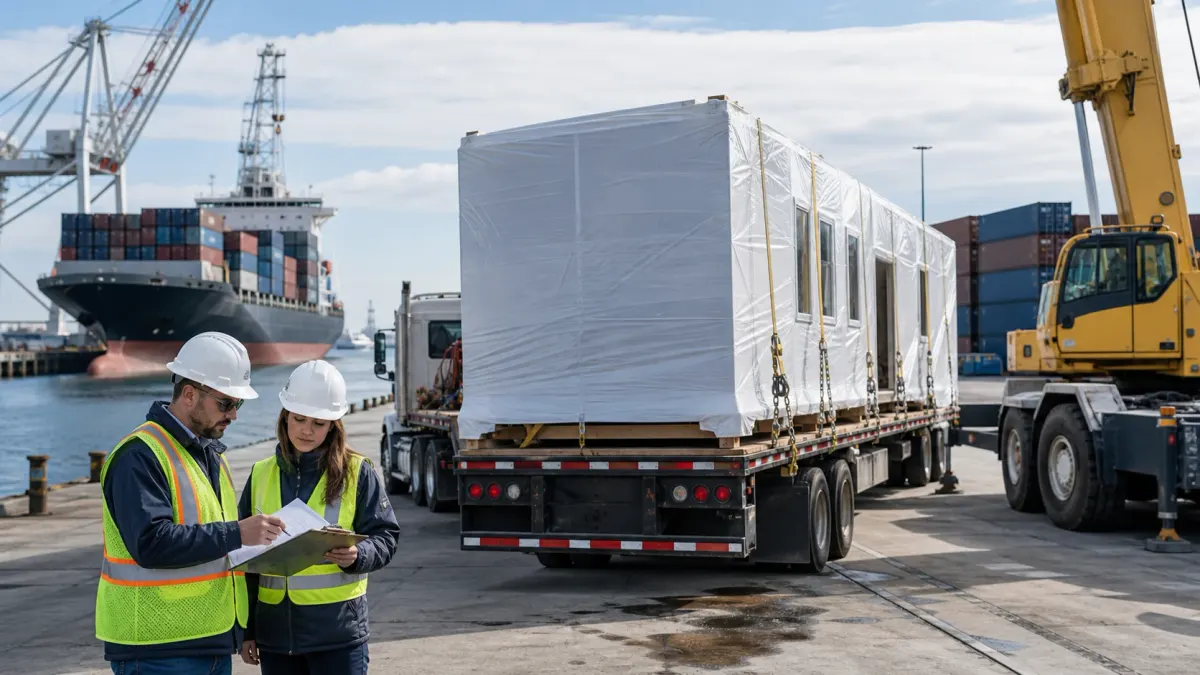
The delivery route should be examined from the factory and export port through arrival, inland transport, site access, staging and final lifting position. Width, height, turning space, road limitations, escort requirements, crane access, overhead obstructions and ground conditions can all affect the format that is practical.
A highly finished volumetric unit may reduce onsite work, but it can increase transport dimensions, lifting requirements and temporary storage constraints.
A panelised system or a system designed for flat packing may use shipping space more efficiently and move through tighter access conditions. The trade-off is greater onsite assembly, weather exposure, sealing work, supervision and quality control.
For that reason, procurement should compare complete delivery systems rather than ex-factory prices alone. Packaging, containerisation or break-bulk requirements, port handling, inland freight, lifting, local labour, temporary protection, waste and damage risk may change the commercial result more than a difference in the factory price.
Define fixed, configurable and local scope before requesting quotations
A strong request for quotation should make clear which decisions have already been made.
Fixed requirements may include the intended building use, target number of rooms, broad structural approach, maximum shipping dimensions, core bathroom arrangement and basic service strategy.
Configurable items may include internal finishes, window positions, furniture packages, cooling equipment, façade treatments and optional energy systems.
Local scope may include site surveys, geotechnical investigation, foundations, utility supply, site drainage, decks, fire infrastructure, landscaping, permits and final inspections.
This structure improves comparison between suppliers because each proposal can respond to the same boundaries.
Assumptions and exclusions also need to be visible. A quotation should not leave major questions around wind design, foundations, electrical work, utility capacity, installation or inland transport hidden behind a low headline price.
The aim is not to force every project detail into the factory contract. It is to make sure each important responsibility has an owner.
Australia’s MMC market is attracting substantial manufacturing interest
Policy support is drawing more manufacturers and technology providers into the market.
The NSW Modern Methods of Construction Industry Expansion Program opened an expression-of-interest process in 2026. NSW reported on 30 September that more than 60 proposals had been received from Australian and international organisations.
The submissions covered modular and prefabricated construction, robotics-enabled production and kit-of-parts manufacturing. Ten proponents were shortlisted to progress to the request-for-proposal stage.
That level of participation is a sign of increasing industry interest. It should not be interpreted as a general preference for imported modular systems. NSW is also seeking to expand advanced manufacturing and supply-chain capability within Australia.
An overseas supplier entering this environment will therefore be assessed against more than price.
Buyers will increasingly expect traceable technical evidence, predictable production control, well-defined transport and installation interfaces, and a credible model for local support.
A supplier that can explain precisely what is designed, manufactured, inspected and handed over at the factory boundary is easier to evaluate than one that offers broad promises without allocating the regulated work at destination.
Use a pre-import readiness checklist before design freeze
Before a modular configuration is released for an Australian project, the team should be able to answer the following questions:
- What is the intended use and likely building classification?
- Which state or territory, local authority and approval process apply?
- Which NCC edition, amendments and jurisdictional provisions form the design basis?
- What site inputs are available for wind, climate, bushfire, cyclone, flood, corrosion, soil and drainage conditions where relevant?
- Which structural, fire, acoustic, thermal, accessibility and service requirements need evidence?
- Which drawings, calculations, test reports, certificates, specifications and factory quality records will be supplied?
- How will design revisions and product substitutions be controlled?
- What is the maximum transport and lifting envelope?
- Who owns port handling, inland freight, storage, crane operations and temporary protection?
- Who designs the foundation and the connection between the module and foundation?
- Which services are completed in the factory, and where does local work begin?
- Who is responsible for installation, testing, inspections, commissioning and completion documents?
- How are factory warranties, local workmanship warranties and third-party equipment warranties divided?
- Which spare parts and maintenance information should travel with the initial shipment?
This checklist does not replace Australian engineering, certification or regulatory advice. Its purpose is to make the project defined enough for those professionals to review it efficiently.
Policy momentum does not remove project responsibility
Australia is giving prefabricated and modular construction a stronger place in housing policy, funding and regulation.
The A$39.3 million intergovernmental program, the national manufacturer certification work, NSW reforms and state-level MMC programs all point toward greater use of offsite manufacturing.
For an international supplier, the most useful response is not to present those reforms as a shortcut to approval.
A defensible factory scope is more specific: confirm the agreed product configuration, maintain controlled production information, prepare inspection and packing records, and complete the agreed export handover.
The Australian project team can then manage the site-specific design, approvals, foundations, transport, lifting, installation, utilities, inspections and completion requirements through the appropriate local parties.
Factory repeatability creates value when it is connected to clear responsibility at the destination. That connection, rather than the label “prefabricated”, is what turns a manufacturing system into a deliverable building project.
Sources
Australian Treasury — Homes for Australia: A National Plan, 28 May 2026
Federal Financial Relations — Advancing Prefabricated and Modular Construction
Australian Building Codes Board — Modern Methods of Construction
Australian Building Codes Board — National Voluntary Certification Scheme consultation
Building Commission NSW — Building Productivity Reforms
NSW Department of Planning, Housing and Infrastructure — Modern Methods of Construction