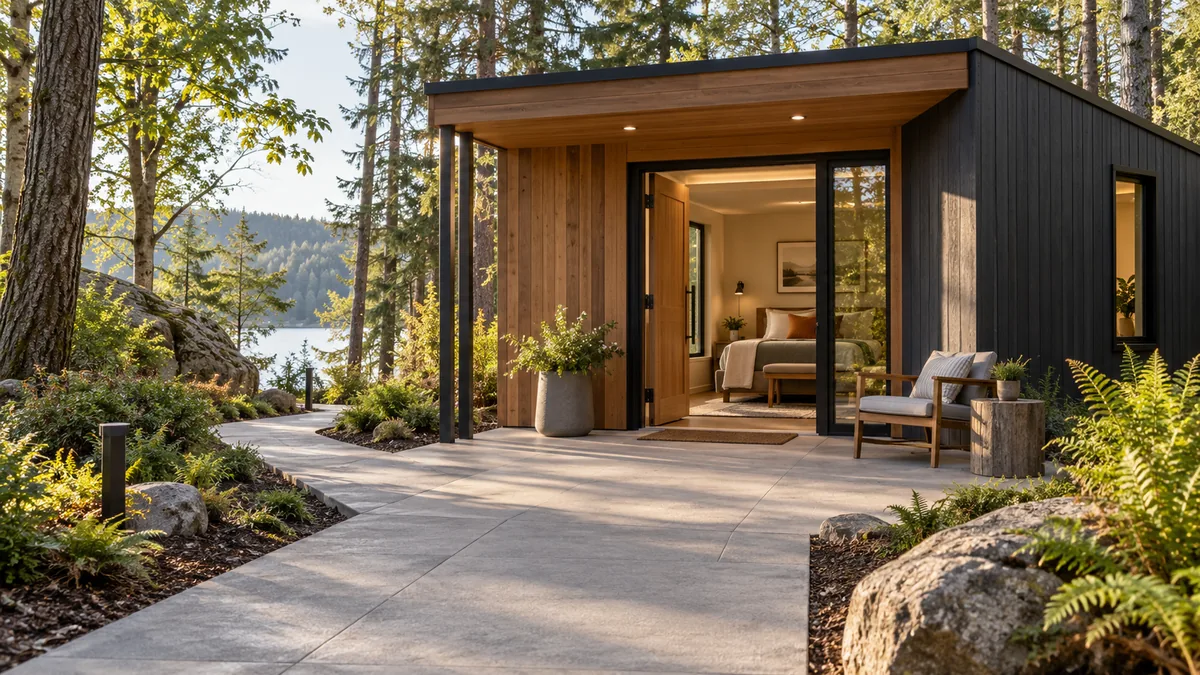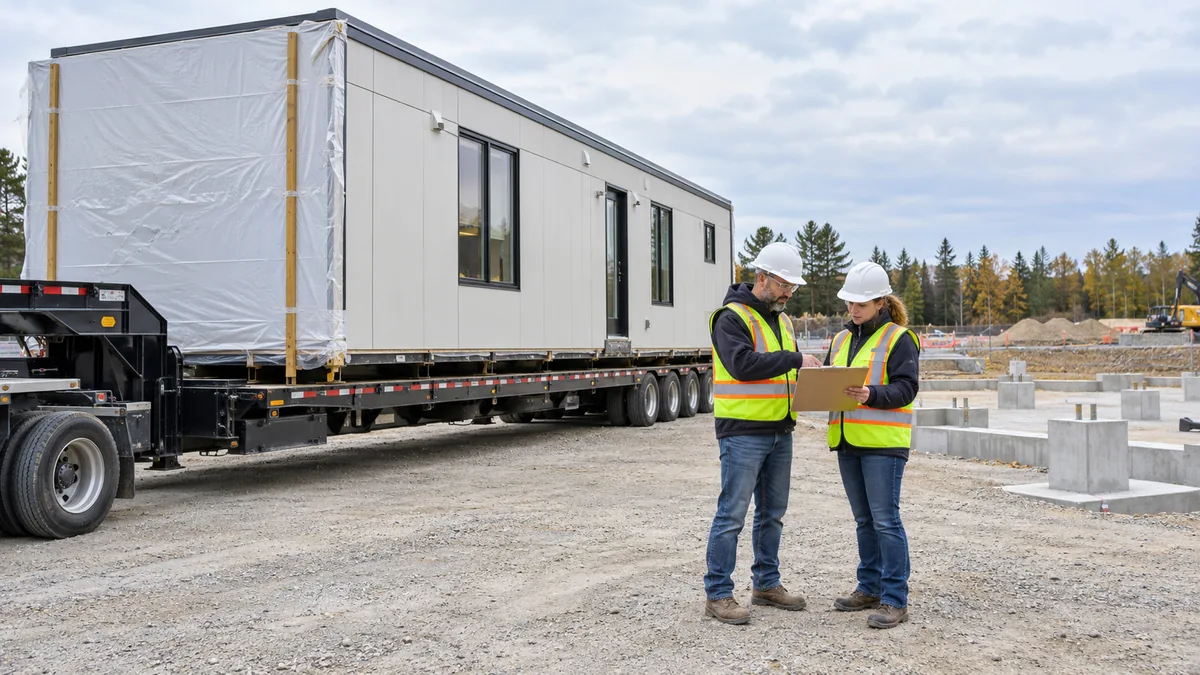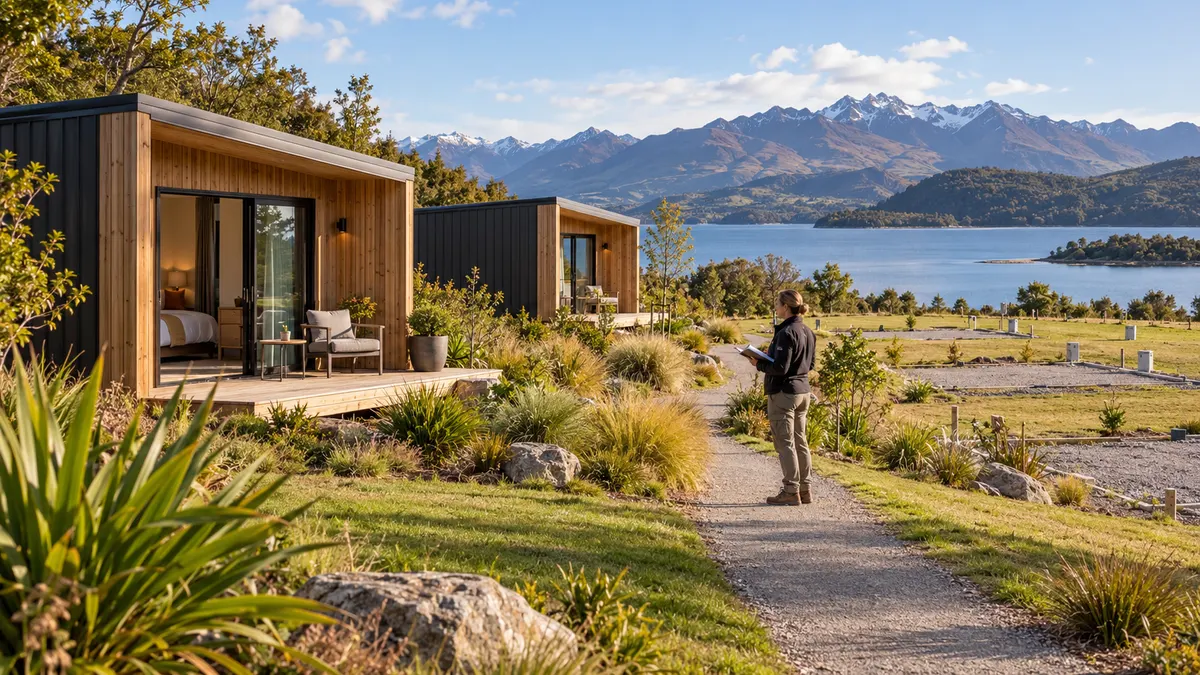
The cover is an AI-generated editorial concept, not a photograph of a completed project or evidence of technical approval.
A recovery signal deserves a local investment test
On 14 October 2026, New Zealand's tourism minister highlighted the latest international visitor figures. Stats NZ recorded 248,700 overseas visitor arrivals in August 2026, compared with 251,100 in August 2019: about 99 percent of the earlier monthly level. The statistical release and the government's commentary are a timely reason for accommodation operators to revisit their plans. They are not evidence that a particular holiday park needs another row of cabins. See the government announcement and Stats NZ release.
For an operator considering modular guest rooms, the useful question is what changed in the business's own booking pattern, service capacity and investment readiness. A national recovery headline can start that investigation; a project-specific evidence pack should determine the next commitment. This article develops an original planning framework for that conversation. It does not forecast visitor demand, prescribe a financing decision or describe a completed MK Mobile House project. The practical objective is to connect an observable opportunity with a room configuration, a prepared site and a commitment that the operator can support.
Separate visitor arrivals from paid cabin nights
An arrival is a border movement within the statistical series. An accommodation purchase is a different decision. Visitors can stay with relatives, use several accommodation types, travel between regions or spend only part of a trip in a holiday park. The operator therefore needs a bridge between the national indicator and the particular product being considered.
Build that bridge with questions rather than a conversion percentage. Which visitor groups currently book the property? Which routes bring them nearby? What length of stay and party size do they request? Are unmet enquiries for a private bathroom, an accessible room, a family layout or simply a different date? A full Saturday can coexist with spare capacity during the rest of the week. Adding identical rooms would address only some of those situations.
Keep international and domestic customers visible in the same local review. An operator's existing guest mix may differ from the national arrivals story. Also separate occupied rooms from occupied beds and booking enquiries from confirmed reservations. Give each measure its own definition, period and source so that a presentation cannot silently turn encouraging attention into contracted room revenue.
Collect the evidence that could change the decision
Start with records the business can reasonably explain: bookings by room type and date, cancellations, group enquiries, unavailable-room searches, guest feedback and housekeeping turnaround. Protect personal information; a planning review rarely needs a guest's identity or message transcript. Aggregated reasons and periods are generally more useful than a folder of individual conversations.
Use a consistent distinction between missing capacity and a mismatch in the offer. A rejected family booking may indicate too few beds, unsuitable sleeping arrangements or a minimum-stay restriction. A request declined during maintenance does not necessarily justify a new permanent cabin. Record the reason and the alternative offered before counting the enquiry as lost demand.
Look beyond one unusual weekend. Compare relevant periods, flag closures and changes in the booking system, and explain differences in availability. Nearby events or a temporarily closed competitor can distort a short sample. When the evidence is limited, make uncertainty part of the decision instead of filling the gap with national averages. The output should be a short demand statement that another operator could challenge: which room type appears constrained, during which periods, for which guests, and what additional evidence would overturn that conclusion?
Define the room that the operator can actually sell
A modular unit becomes accommodation through its relationship with the site and the service offer. Define the complete guest experience before narrowing the discussion to an exterior photograph. Sleeping arrangements, luggage space, bathroom provision, heating and cooling expectations, privacy, maintenance access and the route from parking all affect what can honestly be offered to a guest.
Write a room brief that the operations team and supplier can both review. State intended party size and use, furniture assumptions, cleaning access and consumable storage. Identify which features belong to the factory package and which depend on decks, paths, utilities or other destination work. If accessibility is part of the offer, the local team must review the whole route and room rather than treating one doorway as the entire requirement.
Use the brief to check booking descriptions too. A room with a kitchenette may attract a different stay pattern from a simple overnight cabin, with different cleaning and servicing consequences. A private terrace changes the site layout and upkeep scope. These are planning choices to investigate, not features that every unit should receive. The accessible cabin planning article provides a more detailed discussion of the route-to-room brief.
Compare more rooms with a better existing offer
Prepare at least three responses to the demand statement. One may add a small batch of guest rooms. Another may refurbish or reconfigure existing accommodation. A third may improve availability by addressing maintenance downtime, housekeeping constraints or the booking offer. A larger estate may also be able to redirect guests between existing room categories or properties.
Compare these options against the same problem. If guests want bathrooms rather than additional beds, a general capacity increase can miss the opportunity. If the property loses sales because rooms cannot be cleaned in time, another batch may deepen the bottleneck. Conversely, if the constrained room type is well evidenced and services have spare capacity, additional accommodation deserves a more developed brief.
Include the option to wait and collect better evidence. Waiting has consequences, including continued lost enquiries or delayed replacement of poor rooms, but those consequences should be stated rather than treated as automatically unacceptable. The comparison should produce a reasoned next step, not an assumption that modular supply is always the winning answer. Record why an option was rejected and the condition under which it would become attractive again.
Test the capacity around the cabin
The additional room sits inside an operating system. Ask the local team to review water, wastewater, power, drainage, emergency access, waste collection and the services used by guests and staff. The fact that the property already operates does not establish that every system can support an expansion in its proposed configuration.
Set a boundary for each review. A supplier can describe the unit's agreed equipment and connection information. Local professionals and operators need to establish the destination inputs, infrastructure work and permissions. Keep capacity assumptions separate from completed checks, and do not substitute a nominal equipment label for the site team's assessment.
Operational capacity belongs on the same page. Linen storage, laundry arrangements, cleaning routes, reception coverage and maintenance response may need adjustment even when physical utilities are adequate. Review busy arrival and departure periods rather than only an average day. Include the extra rooms in an operating walk-through and ask where staff will collect supplies, deal with defects and reach equipment. The resulting service brief can reveal a small support-space investment that should precede guest-room orders. It can also show that a proposed room count needs revision before the layout is fixed.
Bring local design and consent questions forward
New Zealand's building authority distinguishes building requirements from the wider question of other consents and permits. Its consent guidance directs applicants to the council for relevant planning requirements. A commercial accommodation expansion needs its own assessment; a domestic small-building example should not be carried across without checking the actual use and scope.
Before choosing a manufacturing slot, identify who will coordinate destination design, council discussions and the information the factory must provide. Give that person the proposed use, site layout, room configuration and connection assumptions. Ask which decisions need to be resolved before manufacture and which information can be developed through the agreed project process.
This is a sequencing recommendation, not a legal determination about a specific property. Keep the current local review visible when a model changes. A previously discussed cabin footprint does not automatically cover a changed layout, a new number of rooms or a different location on the property. The New Zealand product-pathways article explains why product evidence and acceptance of a complete destination project remain different questions.
Work backwards from a room ready for guests
Choose the intended operating condition before selecting an opening date. A delivered unit, an installed unit and a room that can receive paying guests are separate milestones. The programme should connect design decisions, permissions, destination works, factory release, transport, receiving access, installation, inspections, commissioning, furnishing and the operator's final preparation.
Ask each responsible party to identify dependencies and the evidence that closes its stage. If a council decision, utility upgrade or local installation resource is unresolved, show it as an open condition. A factory lead time should not be presented as the complete time to opening. Equally, avoid treating every uncertainty as a reason to stop all useful work: configuration review and information gathering can often proceed while the team resolves another dependency.
Protect the existing guest operation during installation planning. Discuss receiving windows, closed areas, noise-sensitive periods, staff access and how guests will be informed. These are questions for a site-specific plan, not instructions for carrying out lifting work. Link the revised programme to a booking-release decision so that marketing cannot sell a room based solely on a shipment forecast.
Use scenarios to expose the assumptions
A useful commercial review distinguishes incremental income from incremental commitments. Ask the operator's adviser to identify the complete scope: unit supply, destination works, professional input, transport, installation, furnishings, operating preparation, ongoing servicing and the working capital needed before opening. Keep recoverable taxes, finance arrangements and any incentive eligibility within the appropriate professional review.
For demand, compare conditions the business can explain. One scenario may retain the current booking pattern; another may add demand in the constrained room type; a third may assume weaker shoulder-period sales or a delayed opening. Use the same room availability and cost definitions across scenarios. Do not apply a national arrivals growth rate directly to the property's future occupancy or selling price.
The purpose is to identify what the decision depends on, rather than to produce a persuasive return figure. Which assumption most changes the operator's ability to carry the commitment? What additional evidence would improve that assumption? If the investment only works with uninterrupted peak-season selling, the next action may be more local research or a smaller stage. Discuss the result with qualified business advisers before making a financing commitment.
A hypothetical eight-cabin park tests its next move
Consider an invented holiday park with eight existing cabins. The example is a discussion exercise, not measured operating data or a description of an MK customer. The owner initially asks for four more units after seeing the national recovery headline. The booking review, however, identifies repeated requests for family rooms with private bathrooms and a cleaning bottleneck during closely spaced departures.
The team compares three possibilities: add four general-purpose cabins, add two family cabins while improving linen and cleaning support, or upgrade selected existing rooms and review demand again. The local team also finds that the proposed new plot needs further infrastructure review. None of those findings can be settled by a supplier's catalogue photograph.
The immediate decision is therefore to complete two configuration briefs and a site-services assessment before committing to a batch size. The operator records what would justify each option: sustained room-type demand, workable cleaning arrangements, destination readiness and an affordable complete scope. A later review might support two units, four units or no new units.
This example illustrates a decision sequence rather than an optimal answer. Its value lies in making the original request testable. Changing the room mix or improving existing facilities remains a legitimate outcome, even when a national market signal is encouraging.
Record whether to expand, improve or hold
Use a compact decision table at the review meeting. The entries below are editorial prompts, not a council form or a financial approval method. Replace them with the evidence and responsible people appropriate to the property.
| Decision | Evidence to bring | Question to close |
|---|---|---|
| Develop an expansion brief | Repeated room-type demand and an initial local site review | Which rooms and enabling works are actually needed? |
| Improve existing accommodation | Reasons for rejected bookings and a room-condition review | Can the current estate address the constraint? |
| Add support capacity first | Cleaning, linen or maintenance bottlenecks | What enables current and future rooms to operate well? |
| Hold the order | Unresolved demand, infrastructure or funding assumptions | What evidence and review date will reopen the decision? |
For each choice, name an owner, a next action and a condition for review. An open issue should have a route to resolution; a completed review should have a record the next person can understand. Keep the table updated when the configuration, site or intended opening changes. That discipline gives the supplier a clearer question and gives the operator a way to resist an order driven only by a headline.
Turn the next supplier conversation into a defined task
A useful first enquiry describes the destination, intended use, room mix, preliminary site constraints and the information still missing. Ask the supplier to identify the relevant product configuration, included supply scope, available drawings and technical records, packing assumptions, documentation responsibilities and the decisions needed before an offer can become firm. Keep destination design and approval ownership explicit.
MK Mobile House can discuss product supply, configuration and manufacturing coordination within an agreed scope. Local design, permissions, foundations, utility capacity, installation and permission to operate depend on the destination project and its qualified parties. Any additional service or verified product performance should be confirmed for the specific offer rather than inferred from a general article.
Connect the new room brief to the property's established operations and a recorded investment decision. The immediate deliverable might be a reviewed configuration, a local feasibility question or a comparison of two supply options. It need not be a purchase order. A stronger modular project starts when the operator can explain what it needs, why it needs it and which evidence must exist before it commits. Tourism recovery makes that discussion timely; the property's own evidence makes it credible.
Sources
- New Zealand Government: International tourism nears full recovery, 14 October 2026. Official commentary on the monthly national visitor release.
- Stats NZ: International travel, August 2026; released 14 October 2026. National overseas visitor arrivals, not local accommodation occupancy.
- Building Performance: Check if you need consents. General New Zealand consent guidance; no new October policy is asserted here.
Sources checked on 16 October 2026. The assigned article date is 14 October. Planning tables and the eight-cabin example are original editorial analysis, not source-issued forms, measured property data or investment forecasts.