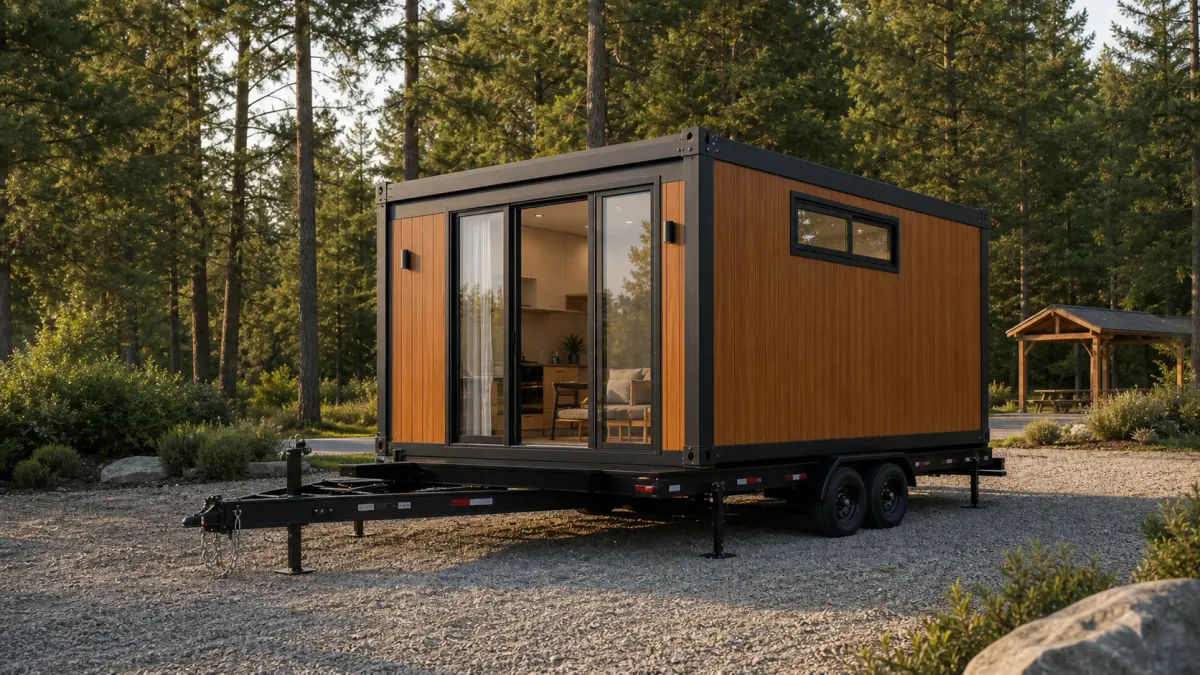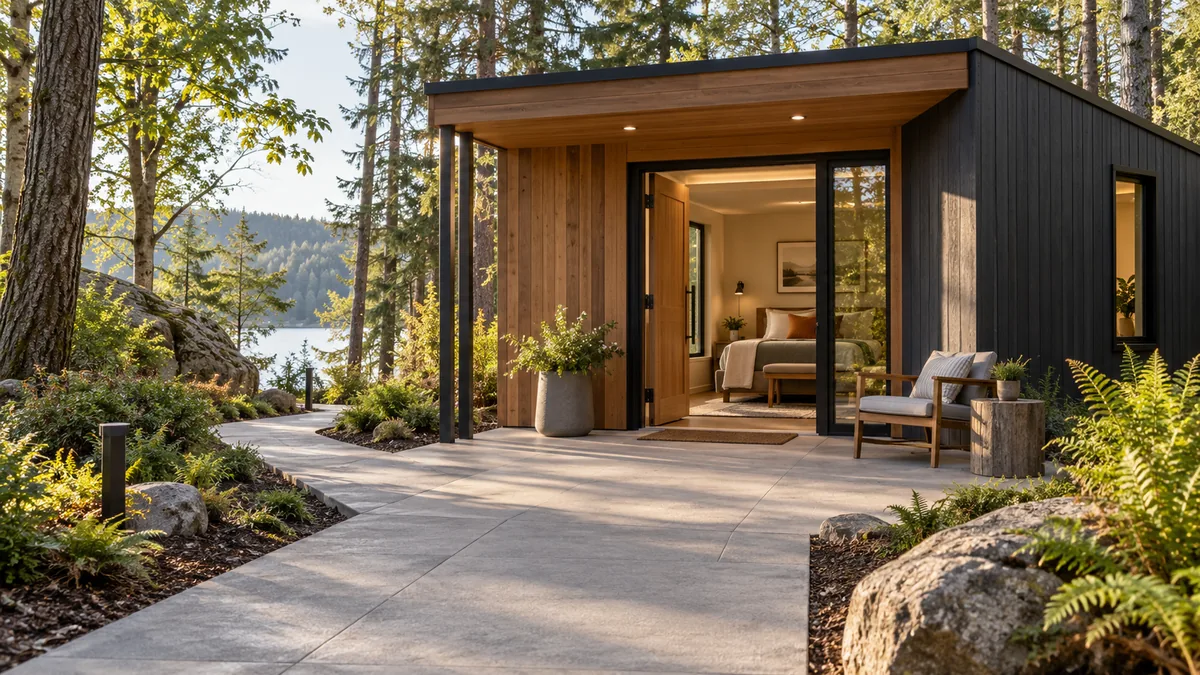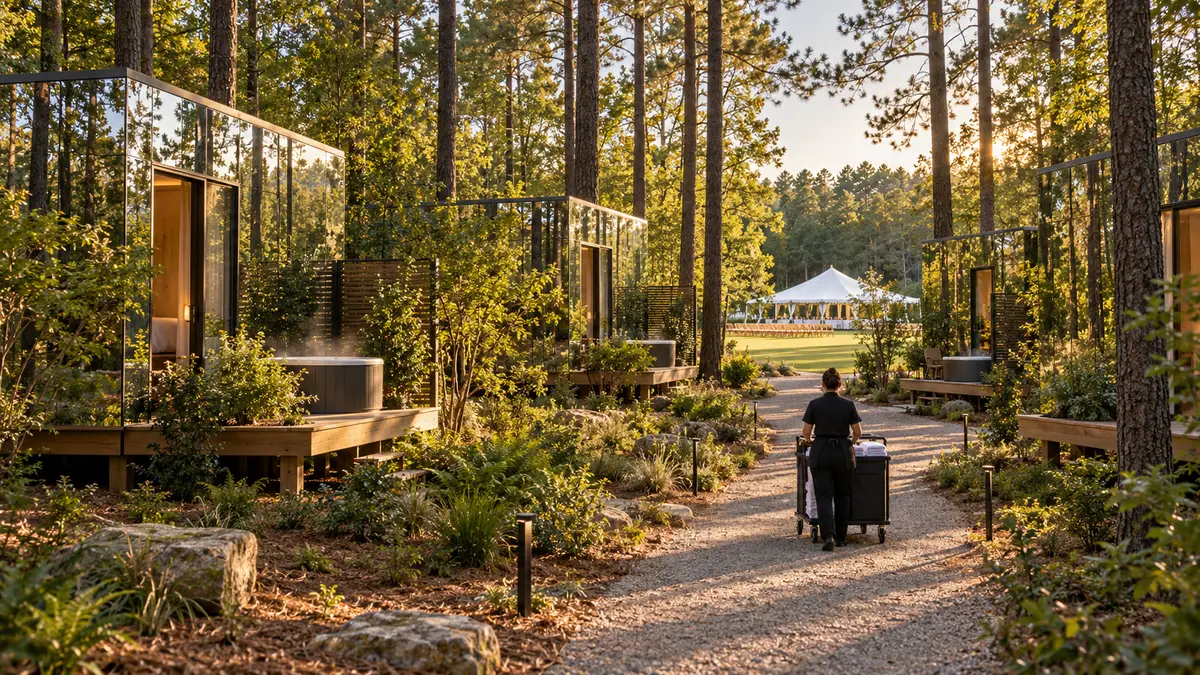
The cover is an AI-generated editorial concept, not a photograph of a completed project or evidence of a commercial relationship.
Why four units can be harder than forty
On 7 October 2026, a press release announced that The Reflections at Dove Hollow, a forest stay on the grounds of an established wedding venue in East Texas, would welcome its first guests on 25 October 2026 with four private mirror houses, each with its own deck and hot tub. The release describes the project as a partnership between the venue's founding sisters and a cabin supplier, and notes that one of the four units is a larger two-room model making its U.S. debut.
That is a small project by any construction measure. Four units, one site, an existing business with existing guests. It is also a complete operating business, and that is the part that tends to be underestimated.
Forty units justify a dedicated operations manager, a housekeeping team, a maintenance technician and a booking system built around accommodation. Four units justify none of those things individually, so every function has to be absorbed by someone who already has another job. The fixed cost does not disappear; it is simply divided by four instead of forty.
The purpose of this article is not to comment on that specific venue's operation, which is not public. It is to set out the decision framework that any established event business should work through before adding a small, high-identity accommodation annex.
Start with the guest the venue already serves
The strongest argument for an annex at an event venue is not that cabins are popular. It is that the venue already has a guest with an unmet need.
At a wedding venue, that need is usually visible in the booking conversation: the couple asks where their party will stay, and the answer is a hotel twenty minutes away. The release describes exactly this pattern, quoting the owners saying that lodging kept coming up as a need for their couples. That is a demand signal from an existing customer base rather than a market projection.
The next step is to characterise that guest precisely. How many rooms does a typical wedding party need? How many nights? Do they want to be on site, or do they prefer a hotel with a bar and a lobby? What price will they accept for a cabin in a field versus a hotel room in town? Which guests are the couple themselves, and which are family, and do those two groups want the same thing?
The answers determine whether the annex is a premium product for the couple and immediate family, an overflow option for the wider party, or an off-season retreat product for couples without a wedding. Those are three different businesses with three different price points and three different service levels. A four-unit annex cannot be all three at once, and pretending otherwise produces a unit that is over-specified for overflow and under-specified for premium.
Decide what the annex is for
Once the guest is characterised, the annex needs an explicit purpose. Four are common.
The first is the wedding-night suite: the couple stays on site, and the unit is part of the package. The second is the immediate-family block: parents and the wedding party stay close, and the venue sells a small cluster. The third is general overflow: any guest can book, and the annex competes with local hotels. The fourth is off-season use: the units operate as a standalone retreat when no wedding is booked.
Each purpose implies a different configuration. A wedding-night suite can justify a premium fit-out and a view. A family block needs multiple similar units and a shared outdoor space. Overflow needs efficient check-in and a price that competes. Off-season retreat needs privacy, self-sufficiency and something to do.
The most common failure is a venue that builds for the first purpose and markets for the third. The unit is beautiful, the price is high, and the guest compares it to a hotel with a restaurant and chooses the hotel. Deciding the purpose first prevents that mismatch.
Test privacy and sightlines before aesthetics
A mirrored cabin is a design gesture, and design gestures have operational consequences.
The mirror effect works in both directions. From inside, floor-to-ceiling glazing gives a view of the trees. From outside, the same glazing can give a view in, depending on light, time of day and the angle. A unit positioned so that a wedding lawn, a ceremony aisle or a parking area looks directly at it has a privacy problem that no amount of interior design solves.
Sightlines should be tested on a site plan before the units are ordered. Mark the unit positions, the deck orientations, the hot tub positions, the approach paths and the ceremony and reception areas. Then mark what each unit can see and what can see it. The exercise usually moves at least one unit.
Acoustic privacy matters as much as visual privacy at an event venue. A cabin two hundred metres from a reception tent is not quiet at eleven at night. A unit positioned behind a service building may be quieter and less scenic, and the trade-off should be made deliberately rather than discovered by the first guest who complains.
Size the service loop for four rooms
The service loop is the set of tasks that happen between guests, and it is where small annexes fail.
Housekeeping for four rooms is not a scaled-down version of housekeeping for forty. It is a task performed by one or two people who also do something else, on a schedule that collides with events. The plan should define who strips and remakes a room, who checks the hot tub, who replaces linen, who cleans the deck, and when those tasks happen relative to check-out and check-in.
Linen is a specific constraint. Four rooms with a two-night stay pattern generate a predictable volume, but a Saturday wedding with a Sunday check-out concentrates the turnover into a few hours. If linen is laundered on site, the machine capacity and the drying time become the bottleneck. If it is outsourced, the collection schedule has to match the turnover, including Sundays and holidays.
Waste is another. A cabin with a kitchenette generates food waste, and a hot tub generates chemical containers and filter waste. Neither is a large volume, but both need a route, a container and a disposal arrangement that does not involve leaving bags beside a wedding marquee.
Plan water, power and heat for the actual climate
East Texas is hot and humid for much of the year, with occasional freezes in winter and severe storms in season. A cabin annex designed for a mild climate will underperform.
Cooling load is the first consideration. A small, well-insulated unit with large glazing can overheat quickly, and a hot tub adds both a heat source and a humidity source. The cooling system should be sized for the actual envelope and the actual occupancy, not for a generic room area.
Humidity is the second. In a humid climate, moisture management matters more than temperature for comfort and for the durability of the building. Ventilation, dehumidification and the detailing of the enclosure all affect whether a unit feels dry or clammy, and whether the interior finishes last.
Freeze risk is the third. A cabin that is unoccupied between events may have water in its lines during a freeze. The plan should define whether units are winterised, kept heated, or drained, and who performs that task and records it.
Power should be planned for the actual loads: cooling, hot tub, water heating, lighting, device charging and any kitchenette equipment. A four-unit annex with four hot tubs has a different electrical profile from four bedrooms, and the supply, distribution and protection should reflect it.
Make maintenance realistic for a small team
A distinctive building is a maintenance commitment, and the more distinctive the materials, the more specific the commitment.
Mirrored or highly reflective surfaces need cleaning that does not scratch, and they show every mark. Seals around glazing need inspection, because a failed seal in a humid climate leads to condensation and eventually to substrate damage. Hot tubs need water chemistry, filter cleaning and periodic servicing, and their covers and surrounds deteriorate in sun.
The realistic question is not whether maintenance is possible but whether it will happen at the frequency the materials require, with the team the venue actually has. A maintenance schedule that assumes a specialist visit every month is a different proposition from one that relies on a staff member with a checklist.
Records make the difference. A simple log per unit, covering cleaning, hot tub chemistry, fault reports and repairs, turns maintenance from a memory exercise into a manageable schedule. It also produces the evidence needed to decide whether a second phase is affordable.
Set a room-readiness standard
"Ready" is a word that means different things to a housekeeper, a manager and a guest. A written standard resolves the difference.
The standard should cover the physical condition of the room, the state of the deck and hot tub, the presence of consumables, the function of heating, cooling and lighting, and the presentation of the unit as a whole. It should be specific enough to be checked in a few minutes and short enough to be used every time.
A photograph-based checklist is often more effective than a written one, because it shows what "ready" looks like rather than describing it. The checklist should also record defects rather than only pass or fail, so that a recurring problem is visible before it becomes a guest complaint.
The standard should be tied to the booking calendar. A unit that is ready at three in the afternoon is not ready if the guest arrives at one. The readiness check should happen at a defined point before arrival, with enough time to fix what it finds.
Price the package, not just the cabin
A cabin rate that covers only the room will underprice the operation.
The package includes the room, the deck and hot tub, the linen and consumables, the cleaning, the utilities, the maintenance provision, the booking and payment processing, and the staff time to deliver all of it. It also includes the risk of a vacant night, which is higher for a four-unit annex than for a hotel with a hundred rooms because there is less inventory to average across.
The pricing decision should therefore start from the cost of delivering a night, not from a competitor's room rate. A hotel in town has a different cost structure, a different amenity set and a different guest expectation. Matching its rate with a cabin that cannot offer a restaurant or a lobby is a way to lose money gracefully.
Packaging matters too. A wedding package that includes the cabin for the couple, and a block rate for the family, may produce more revenue and better guest experience than selling rooms individually. The packaging decision should reflect the purpose defined earlier, not a generic revenue-management rule.
Work through a hypothetical four-unit annex
Consider a hypothetical wedding venue with an established Saturday business, adding four cabins. The numbers here are illustrative and are not drawn from the venue in the press release.
The venue's first plan is to run the cabins with existing staff and a cleaning contractor, and to sell them individually at a rate benchmarked against a local hotel. A review surfaces three problems. The cleaning contractor does not work Sundays, which is the main check-out day. The individual rate does not cover the hot tub servicing. And the booking system treats the cabins as an add-on rather than as inventory with its own calendar.
The revised plan changes three things. A Sunday turnover arrangement is agreed with the contractor, with a defined response time for defects. The rate is rebuilt from a cost-per-night model that includes hot tub servicing and a maintenance reserve. The cabins are packaged as a wedding-weekend block for the couple and immediate family, with individual nights sold only in the off-season.
The revised plan does not add units. It adds definitions: who cleans on Sunday, what the rate has to cover, and what the cabins are for. Those definitions are what make the first season measurable, and they are the evidence base for any second phase.
Use an add, pilot, stage or decline matrix
Four positions are available, and choosing one deliberately is better than defaulting to the most ambitious.
Add means the annex proceeds at the planned scale, with the operating model defined. Pilot means one or two units are built to test demand, service load and guest response before committing to four. Stage means the site and services are designed for four but the units are added in phases as demand is proven. Decline means the analysis shows the annex would not cover its operating cost, and the capital is better used elsewhere.
Each row should record the evidence held, the evidence missing, the owner and the review date. The matrix should also record the trigger that would move the decision: a defined occupancy threshold, a service performance measure, or a cost per room that the rate can absorb.
The pilot option is often dismissed as cautious. For a four-unit annex it is often the most financially rational choice, because it tests the service loop at the scale where the loop is most fragile.
Decide what would justify a second phase
A second phase should be justified by evidence from the first, and the evidence should be defined before the first season starts.
Four measures are useful. Occupancy outside peak wedding dates shows whether the annex has a market beyond the existing guest. The share of bookings that would have been lost without on-site accommodation shows whether the annex is creating revenue or merely relocating it. Service performance at full occupancy shows whether the operating model holds when all four units turn over on the same day. Maintenance cost per room shows whether the building is behaving as expected.
Each measure needs a threshold and a review point. "If off-season occupancy exceeds a defined level for two consecutive quarters, and service performance holds at full occupancy, we will evaluate a second phase" is a decision rule. "If it goes well, we will build more" is not.
Two cautions close the loop. The press release describes an opening and a partnership; it does not state construction method, price, occupancy, performance or guest satisfaction, and none of those should be inferred from it. And a distinctive design is not by itself a business model; it creates attention, which is useful, but the operating loop is what determines whether the annex makes money.
Sources
- Stay ÖÖD / Dove Hollow press release, "A New Design-Led Forest Retreat Is Redefining the Bridal Stay in East Texas", 7 October 2026. https://oodhouse.prowly.com/473319-a-new-design-led-forest-retreat-is-redefining-the-bridal-stay-in-east-texas
Source note: the release was read on 24 October 2026. It states that The Reflections at Dove Hollow opens on 25 October 2026 with four private mirror houses, each with a private deck and hot tub, on the grounds of an established wedding venue; that it is described as the U.S. debut of a larger two-room model; and that it was created by two sisters of Dove Hollow Estate in partnership with the cabin supplier. It does not state construction method, modular status, price, occupancy, performance, guest satisfaction or MK involvement. The operating framework, hypothetical annex and decision matrix are original editorial analysis.